
Structural Steel · T Section
Steel T Section, Specified by Geometry and Product Form
A T section is chosen for the shape of its connection: one projecting leg standing off a flat back. That is a detail decision before it is a material one — and the first thing to settle is whether the T is rolled as a T or cut from a parent beam, because the two arrive with different edges, tolerances and economics.
Price on request · Product form, geometry and grade confirmed before quoting
Fit & Selection
When a T section is the right purchase line — and what it commits you to
A T earns its place when the detail needs one projecting leg off a flat back. These are the points that decide whether it does, and each one is settled before the steel is ordered rather than after.
The direct answer
Specify a T section when the detail needs a single projecting leg off a flat back — for a chord, a chord splice, a bracket or a connection stub. Confirm whether it is a rolled T or cut from a parent beam, state the web and flange geometry separately, and keep the material grade as its own field. Capacity and load path stay with the engineer of record.
The detail needs a projecting leg
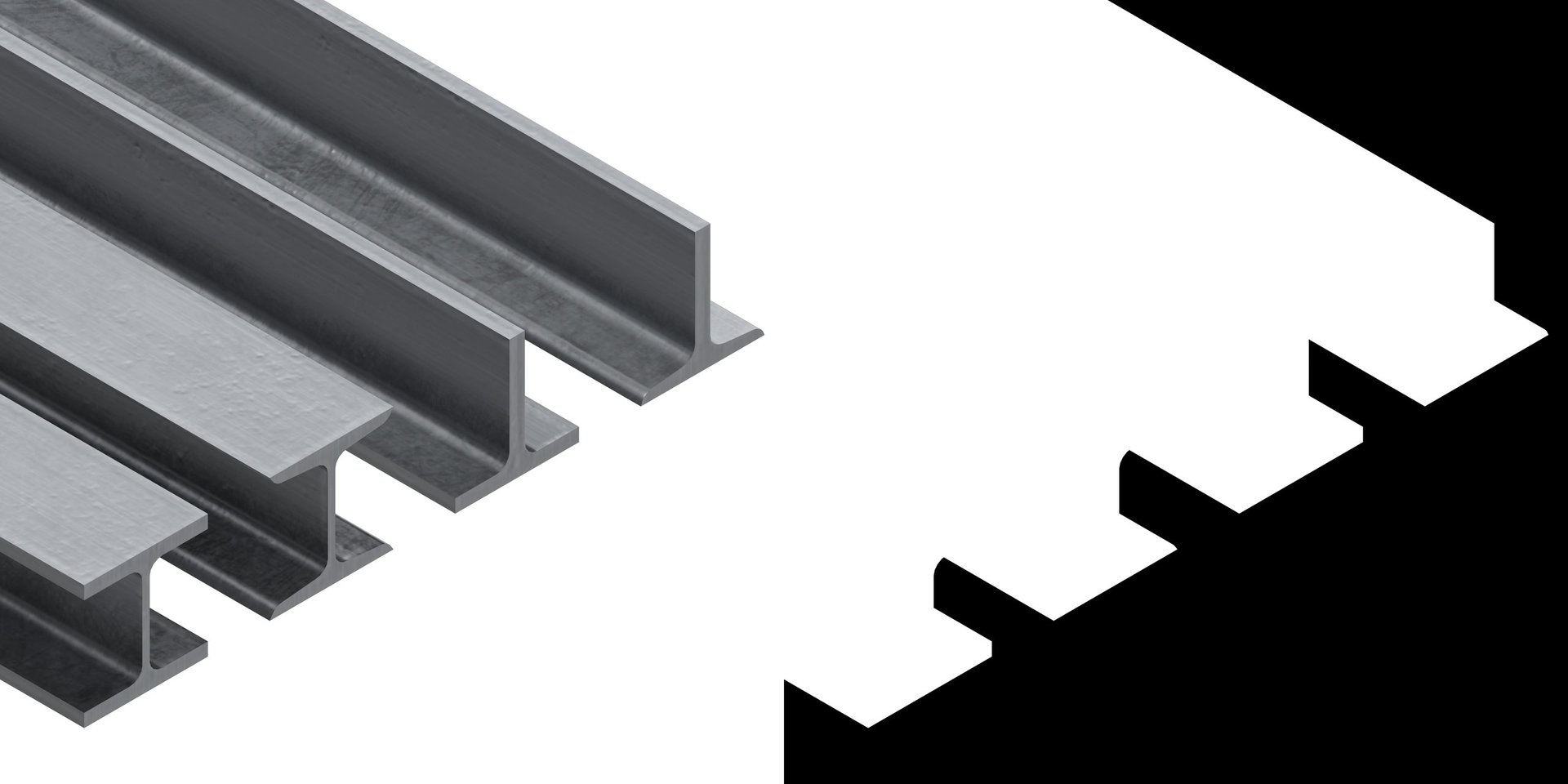
A T section gives you one leg standing off a flat back, which is what makes it useful for a chord, a stub, a bracket or a connection where a single projecting element is required. If the detail needs two legs at right angles, an angle is the more direct answer; if it needs a flat face only, flat bar is.
The shape is chosen for the connection geometry. This page will not tell you the section is strong enough for the load — that is the engineer of record's determination.
Rolled T or cut from a parent beam
A T can be supplied as a rolled profile in its own right, or cut from a parent beam or H section. A rolled T carries its own tolerances and arrives with its own edge condition; a cut T inherits the parent member's tolerances and leaves a cut face where the web was severed. The two are bought on different terms and are not interchangeable by default.
Confirm which product form the drawing intends before the enquiry is priced. A cut T is not an automatic substitute for a rolled T, and the cut face may need machining or a different connection detail.
Geometry has to be stated field by field
A T is described by its depth, its flange width, the flange thickness and the web thickness — and those four fields do not travel together inside a single shorthand. Two Ts of the same depth can differ in every other dimension, so a callout that names only the depth has not specified a section.
State each dimension with units and against the dimensional standard that defines the series. A nominal depth is a family description, not a specification.
The orientation has to be shown, not assumed
A T can be used stem-up, stem-down or on its side, and the orientation changes what the connection sees and how the leg is loaded. An orientation that is implied but not drawn is one the fabricator has to guess — and a guess here is cheap to make and expensive to discover.
Show the orientation on the detail. Whether a given orientation is adequate is a design question, not a supply one.
Fabricability follows from the form
A rolled T is handled as its own member. A cut T arrives as a parent section that has been severed, so cutting, straightening and any residual stress considerations belong to whoever produces it. Drilling, notching and welding then follow from which form you bought.
Where the T is cut, establish who is cutting it and to what tolerance. That allocation belongs in the enquiry rather than in the shop drawing stage.
The material grade is a separate field
A T section's shape and its steel are governed by different documents. The dimensional standard defines the profile; the material standard defines the grade. A callout that names one and not the other has left half the requirement unstated, whichever half it named.
Where a grade has to be evidenced, the certificate is issued against the material standard — and for a cut T, it evidences the parent member rather than a rolled T product.
This page sits inside the whole section range
A T is one family among several open sections, and the choice between them turns on connection geometry rather than on price. The full range of shapes — with the member question each one answers — is on the types hub, and that is the better place to start if the shape itself is still open.
Settle these before the enquiry
- Rolled T, or cut from a parent beam
- Orientation of the leg on the detail
- All four section dimensions, with units
- Material grade, as its own field
- Who cuts, and to what tolerance
T-Section Enquiry Builder
State the detail and this page assembles the enquiry
This is a completeness builder, not a capacity calculator. It returns no section property, no load, no price — it returns the fields your enquiry still has to carry, the adjacent shapes worth comparing, and a summary you can hand to the commercial desk.
Five enquiry fields
0 / 5 answeredAll five are required. The product form and the leg orientation are the two most often left to the shop — and the two that change the quote most.
Your enquiry appears here
Set the five fields on the left and build the enquiry. The result reports what is still open, which adjacent shapes are worth comparing against your detail, and the fields to carry into the RFQ.
Geometry & Specification
Six fields that describe a T section — and the one buyers quote alone
Depth is the dimension most often written on a schedule and the one that specifies the least. A T is defined by its four section dimensions together, plus the form it is supplied in and how it is cut.
| Field | What it determines |
|---|---|
| Depth | The overall height of the section, measured through the web. It is the dimension most often quoted alone — and the one that specifies the least. |
| Flange width | The width of the flat back. This is what determines the area available for bolting or welding to the surface behind the leg. |
| Flange thickness | The thickness of the flat back. It governs how much material the connection has to work with, and it is rarely implied by the depth. |
| Web thickness | The thickness of the projecting leg. Two sections of the same depth and width can differ here, and the leg is usually the element carrying the load into the connection. |
| Section length and cut lengths | Whether mill lengths are acceptable or the member has to arrive at a cut length, and to what tolerance the ends are to be prepared. |
| Product form | Rolled T or cut from a parent member. This field changes the tolerances, the edge condition and who carries the cutting. |
These are the fields this page can tell you matter. The permitted tolerances on each dimension, and the exact figures for any designation, are set by the dimensional standard that governs your series — not by this page.
The designation problem a T section has that a beam does not
A parent beam usually carries a well-known series designation that encodes its geometry. A T section is frequently specified without one — because it may not be a rolled product at all — so the drawing falls back on stating dimensions, or on naming a parent member to be cut. That is why a T enquiry so often arrives as a depth and nothing else. Stating all four dimensions, and the form, is what makes the enquiry quotable without a follow-up round.

The grade is a separate conversation
The shape and the steel are governed by different documents. Where a grade is called for, it is stated against the material standard and evidenced on the certificate issued for the heat — and for a cut T, that certificate describes the parent member rather than a rolled T product.
A grade used widely in GCC project workQuality & Documents
What the evidence has to line up with
For a T section the question is not only what the certificate says, but which product it describes — because a rolled T and a cut T produce genuinely different documents.
The certificate follows the product form
A rolled T and a T cut from a parent beam do not produce the same evidence. Where the T is cut, the certificate describes the parent member and its heat, and the delivered item is a product of that member. Reconciling the document against the drawing means knowing which of the two you bought.
Geometry is verified by measurement, not by certificate
The four section dimensions sit in the dimensional standard, and they are checked with instruments against the permitted tolerances. A material certificate evidences the steel, not the profile — so dimensional and material verification are two separate exercises.
The cut face is its own consideration
Where a T is severed from a parent member, the cut face has an edge condition and a straightness that the parent product standard does not describe. If the connection or the fit-up depends on that face, say so in the enquiry rather than assuming a mill finish.
Orientation and handling marks matter on delivery
Because a T is asymmetric, it can be delivered rotated relative to how it will sit in the works. Where orientation matters to the connection, state it so that handling and site placement match the detail rather than the pack.
What to ask to be evidenced
- The document that covers the form actually supplied — rolled T, or the parent member it was cut from
- The material standard, edition and grade as supplied, stated separately from the section description
- The heat or cast identity, and how traceability carries through cutting and fabrication
- The dimensional standard the section series belongs to, so the geometry can be checked against a permitted tolerance
- Where the cut face matters to fit-up, what condition it is expected to arrive in
- Any supplementary requirement the project adds beyond the standard citations
Confirm which certificate, test and marking your project's standard actually requires, against the standard itself and the edition the project is bound to. This page does not state those requirements.
Applications
Where a projecting-leg member earns its place
The application does not change the shape decision — but it does change which material, inspection and documentation requirements arrive with it.
Chords and chord splices in fabricated girders
A T is often used where a projecting leg has to run along the edge of a fabricated member and carry the connection out to the next element. The leg orientation is the whole point of the choice, and it is what the detail should show.
Brackets, stubs and connection stubs
Where a short projection is needed off a face, a T gives the leg and the back in one piece rather than requiring two members to be welded into a T-shape from flat bar or plate.
Offshore and marine structures
Structural members on offshore work bring their own material and inspection requirements on top of the shape decision, and those requirements are set by the project rather than by the section.
offshore structural steel supplierPower plant and heavy industrial framing
Plant structures frequently use projecting-leg details around equipment supports and connection points, where the orientation of the leg is fixed by the equipment interface.
power plant structural steel supplierTransmission and lattice structures
Lattice work uses projecting-leg members heavily, and the detailing conventions of the structure usually decide the shape before the material is considered.
transmission tower steel supplierGeneral fabrication and repair work
In the shop, a T is frequently the shortest route to a projecting element where the alternative is welding a built-up shape from flat bar and plate — provided the bought form suits the tolerance the detail needs.
GCC Supply
The shape decision travels; the shipment planning does not
A T section means the same thing in Dubai as in Dammam. What changes by destination is the documentation pack, the discharge port and the handling the long product needs in transit.

United Arab Emirates
Local supply and re-export enquiries, where the section form and the certificate requirement are usually confirmed on the same schedule.
Structural steel for United Arab Emirates
Saudi Arabia
Large project packages where the documentation pack and the inland route shape the order as much as the section does.
Structural steel for Saudi Arabia
Qatar
Project-driven demand where the technical submittal is prepared alongside the section enquiry rather than after it.
Structural steel for Qatar
Oman
Port-led planning: confirm the discharge point, the documents required and the Incoterm before the tonnage is fixed.
Structural steel for Oman
Bahrain
Shorter sea legs where handling at both ends, rather than transit time, is usually the constraint to plan around.
Structural steel for Bahrain
Kuwait
Industrial and infrastructure demand, where the section form and the paperwork have to be agreed before the steel is committed.
Structural steel for KuwaitThese pages set out the supply route and the enquiry handling for each destination. They do not claim local warehousing, stockholding, a branch presence or a delivery timescale — those are confirmed against your own order, not stated in advance.
Commercial & Logistics
What a T-section quotation is built from
A quotation is assembled from stated fields. Where one is missing, the figure returned rests on an assumption — and assumptions are what make two quotations for the same detail incomparable.
Where a field is unknown it is carried into the enquiry marked verify-before-quote rather than filled with an assumption. Load-path and capacity decisions remain with the engineer of record.
Two quotations are only comparable when both rest on the same fields
A price returned against a depth alone and a price returned against a full geometry with a named form are not the same offer, even when the numbers sit close together. Stating the fields first is what makes a comparison meaningful rather than merely numerical.
Adjacent Shapes
What each neighbouring shape is actually for
A T is often considered alongside four other sections. The comparison that matters is connection geometry and fabricability — not which one happens to price lowest.
Steel angle
Choose it when: The detail needs two legs at right angles — a corner, a cleat or a brace connection with work in two directions.
How it differs: An angle is a bent section with two legs meeting at a corner; a T is a section with one leg centred on a flat back. They are different shapes solving different connection geometries, and one is not a substitute for the other.
Steel flat bar
Choose it when: Only a flat face is needed, and the projection can be provided by a separate member or by the arrangement rather than by the section itself.
How it differs: Flat bar is a solid rectangular section with no projecting leg at all. Where the leg is the reason for choosing a T, flat bar does not provide it.
I-beam and H-beam
Choose it when: The member spans or carries load along its length, rather than providing a projecting connection face.
How it differs: A T can be produced by cutting one of these, which is why they are often mentioned together — but as bought products they serve different roles. A parent beam is a spanning member; a cut T is a projection-producing item.
Steel channel
Choose it when: An open profile with two returns is wanted for framing, bracing or edge work rather than a single projecting leg.
How it differs: A channel is an open section with two flanges on one side of a web. It offers two faces rather than one, and its detailing conventions differ accordingly.
Hollow sections
Choose it when: A closed profile is wanted, bought by wall thickness against its own dimensional standard, and the connection is designed around a closed section.
How it differs: A hollow section encloses its cross-section and is a separate product line with its own tolerances, material options and connection practice. It is not an open-section alternative to a T.
hollow sections supplierThese are descriptions of what each shape is for, not a substitution guide. Swapping one shape for another changes the detail, and where an alternative is permitted it is approved by the design authority for that specific connection rather than inferred at the point of order.
Where the governing dimension is the parent beam rather than the T itself, the published size references for that series are the place to read the figures, since this page deliberately states none.
Beam series size referenceExpert Insight
Why geometry is a certificate question only on one side
A point that decides most T-section document disputes: the certificate and the drawing are verifying two different things, and neither can do the other's job.
A mill certificate is a statement about the steel: what it was made from, what it was tested to, and the results of those tests. It is evidenced against the material standard, and it travels with the heat that produced the material. What it does not do is describe the shape — because the profile, and the tolerances permitted on it, live in the dimensional standard instead.
That division is what makes T-section verification a two-part exercise. The geometry is confirmed by measuring the delivered item against the permitted tolerances for its series. The material is confirmed by reading the certificate against the grade the drawing cited. A document check alone cannot tell you the section is the right shape, and a dimensional check alone cannot tell you the steel is the right grade.
Where the T has been cut from a parent member, a third consideration enters: the certificate describes the parent, and the cut face is a product of a process the parent's standard does not describe. If the fit-up depends on that face, the condition it is expected to arrive in belongs in the enquiry rather than in the shop drawing.
What this page does not state
- No section dimension, mass, radius or tolerance value is quoted here. Those belong to the dimensional standard that defines the series, at the size you are buying.
- No structural capacity, resistance, stress or load figure. Those are determined by the engineer of record against the design code and the actual loads.
- No claim that any section is superior, stronger or more economical than another. Every family answers a different detail.
- No stock, availability or lead-time statement. Availability is confirmed against your own enquiry.
Where a requirement has to be checked, check it with the publisher of the governing standard or with the engineer of record — and record the edition you checked against.
Buyer Advantages
What we do about the things that go wrong
Each item below starts from a real procurement concern on a T-section order, states the practice that addresses it, and ends at the outcome it produces.
The product form is settled at enquiry, not at the shop
Most T-section problems trace back to a form decision — rolled or cut — that was never made explicitly. Establishing it in the enquiry is what prevents a fabricator discovering mid-job that they are working a cut face the detail did not account for.
Geometry is collected field by field
The enquiry builder asks for depth, flange width, flange thickness and web thickness as separate fields, with units and a dimensional basis. That is the difference between a section that can be quoted against and a nominal depth that has to be interpreted.
Grade stays a separate line
The material grade is carried as its own field throughout, never folded into the shape description. That keeps the shape conversation and the steel conversation separate — which is what makes both checkable against their own documents.
Open fields are marked, not filled with assumptions
Where a field is unknown, the enquiry carries it forward as verify-before-quote rather than inventing a value. A quotation built on a stated assumption and a quotation built on a silent one look identical on the page and behave completely differently on delivery.
Adjacent shapes are compared on the decision, not on price
The comparison region sets out what each neighbouring shape is actually for, so the choice is made on connection geometry and fabricability. Substituting a nearby section to save cost is a change of detail, not a discount.
Capacity stays with the engineer
Nothing on this page computes a load, a stress or a capacity, and nothing asserts that a section is adequate. That boundary is stated rather than implied, because a supplier's product page is not a design authority.
None of these rest on a claim about scale, stock, price or lead time. They describe how an enquiry is assembled and where the responsibility boundaries sit — which is what can be stated honestly before an order exists.
Enquiry to Delivery
Who owns what, at every stage
A T-section order moves through six stages. Each one names what comes out of it, who is responsible, and what a missing output costs later.
| Stage | Owner | Output |
|---|---|---|
| Establish the detail | Designer or detailer | A drawn connection showing orientation, what the leg connects to, and the faces available for bolting or welding. |
| Settle the product form | Buyer with the fabricator | A decision between a rolled T and a T cut from a parent member, with the cutting responsibility allocated. |
| State the geometry | Buyer or estimator | Depth, flange width, flange thickness and web thickness, with units and the dimensional standard that governs the series. |
| State the material and evidence | Buyer, against the project specification | Material standard, grade designation, and the certificate type the project accepts — named separately from the shape. |
| Enquire and reconcile | Commercial desk and buyer | A quotation built on stated fields, with any open item marked verify-before-quote rather than assumed. |
| Verify on delivery | QA or receiving inspection | Dimensional check against the section standard, and a document check against the form that was actually supplied. |
The stage that is most often skipped
Settling the product form is the step that gets compressed most often, usually because a schedule simply says "T section" and everyone assumes the other party has decided how it will be produced. That assumption is cheap while the enquiry is being written and expensive once the steel is cut — which is exactly why the builder above asks for it as its own field rather than folding it into the shape description.
FAQ
Questions that come up once the detail is drawn
Is a T section just half an I-beam?
Functionally it can be produced that way, and cutting a parent beam is a real route to a T — but as bought products they are not the same thing. A parent beam is a spanning member with its own product standard; a T is a projecting-leg item, and if it is cut from a beam it inherits that parent's tolerances and arrives with a cut face. Confirm which form the drawing intends rather than assuming the two are interchangeable.
Can I substitute a T section for an angle if the legs are similar?
Not on that basis. An angle has two legs meeting at a corner; a T has one leg centred on a flat back. Those are different connection geometries, so a substitution changes what the detail can bolt or weld to. Where an alternative is permitted at all, the permission comes from the design authority and is recorded for that specific detail.
What dimensions do I need to state for a T section?
Depth, flange width, flange thickness and web thickness, each with units and against the dimensional standard that defines the series. A nominal depth on its own is a family description — two Ts of the same depth can differ in every other dimension, so the depth alone does not specify a section.
Does the material certificate cover the T section itself?
It depends on the product form. For a rolled T, the certificate is issued against the T product. Where the T is cut from a parent member, the certificate describes that parent and its heat, and the delivered item is a product of it. Reconciling the document against the drawing therefore starts with knowing which form you bought.
Can this page tell me if a T section is strong enough?
No. Capacity, load path and adequacy are determinations for the engineer of record, made against the design code and the actual loads. This page helps you specify the shape correctly and assemble an enquiry the commercial desk can quote against — it deliberately stops before any structural calculation.
What if I do not know which product form I need?
Then that is worth settling with your fabricator before the enquiry, and the builder will carry it forward as an open item rather than choosing for you. The form affects tolerances, the edge condition on the cut face, and who carries the cutting — so it changes the quote as much as the drawing.
Request a quote for T Section
Send the product form, the four section dimensions with units, the dimensional standard, the material grade, the quantities and the destination — or send it with some of those still open and say which. Price is always on request.
Office 3303, Churchill Executive Tower, Business Bay, Dubai, United Arab Emirates
Monday – Saturday: 8.00 AM – 6.00 PM · Sunday: Closed
Drawn from the parent range
This page covers one section family. The full structural range — types, materials, grades and standards — sits one level up, and its enquiry desk handles the same package.
Structural steel range and RFQ