
Steel Coil · Handling Reference
Steel Coil ID & OD Guide
A coil that meets the material specification can still be refused at the gate. Inner diameter, outer diameter, mass and eye orientation are what decide whether it fits the mandrel, clears the lifting gear and sits where it has to sit — and none of them can be settled from the grade alone.
Technical review before quotation Eye orientation stated on the order Packing matched to the receiving site
No coil mass is calculated on this page. Mass is a measured, packing-list quantity that depends on the wound condition of the coil, so a figure derived from an outer diameter would be a guess presented as data. Review the steel coil standards for the material side of the requirement.
Handling fit check
Enter the limits your equipment imposes, not the coil you hope to receive
This check works from the receiving end. Enter the mandrel bore, the maximum outer diameter and mass your lifting gear can take, and the eye orientation you need. It reports which constraints are still open and flags the combinations that most often cause a coil to be turned away or re-handled on arrival.
Nothing here is sent until you choose to send it. Give the true limit of the machine, not a comfortable round number — a mass limit that is 500 kg optimistic is the kind that only shows up when the crane is already loaded.
Nothing entered yet
Enter the limits your handling equipment actually imposes. The check reports which of the four receiving constraints are still open and flags the combinations that usually cause a coil to be refused at the gate — it does not calculate a coil mass, because the outer diameter alone cannot give one.
Why there is no mass calculator here
A coiled strip is an annulus, and its mass depends on outer diameter, inner diameter, strip width, thickness and density together — five terms, not one. The layers also do not sit perfectly tight, so even the full set of nominal figures gives an estimate rather than a weight. Coil weight reference shows the inputs that calculation actually needs.
The dimensions
Inner diameter, outer diameter and the eye
Three terms carry almost every handling decision on a coil, and two of them describe the same physical feature from different directions. Getting the vocabulary straight first makes the rest of the receiving conversation much shorter.
Inner diameter (ID)
The bore through the middle of the coil, measured across the inside of the wound layers. This is the number that has to match the mandrel, and it is the one a coil cannot be re-worked to fix — a bore that is wrong for the line has no workaround on site.
Outer diameter (OD)
The outside of the wound coil, measured across the full build-up. It governs whether the coil clears the lifting gear, the racking, the door opening and the transport envelope. It also changes as the coil is unwound, so the figure that matters is the one as delivered.
The eye
The open bore seen end-on. Eye to sky means the bore is vertical and the coil rests on its face; eye to wall means the bore is horizontal and the coil rests on its outer diameter. The same coil can be supplied either way, but the lifting gear and lashing are not the same.
What the two orientations change
Orientation is not a cosmetic preference. It changes how the coil is lifted, how it is lashed, how much floor area it takes and whether it can be stacked. If the receiving site needs a different orientation from the one the coil is packed in, that is a re-handling operation with its own equipment and its own risk.
- Bore measured loosely and matched to the wrong mandrel
- Outer diameter quoted from the drawing, not as delivered
- Eye orientation left to the supplier's default
- Re-orientation planned without the right lifting gear
- Stack height set without the outer diameter
- Sleeve or adapter fit assumed rather than confirmed
Measured or estimated
What the numbers on a coil offer actually are
Two coils with identical outer diameters can weigh very different amounts, because the outer diameter fixes only one of the terms that determine mass. Knowing which figures are measured and which are estimated is what stops a handling limit being exceeded on paper.
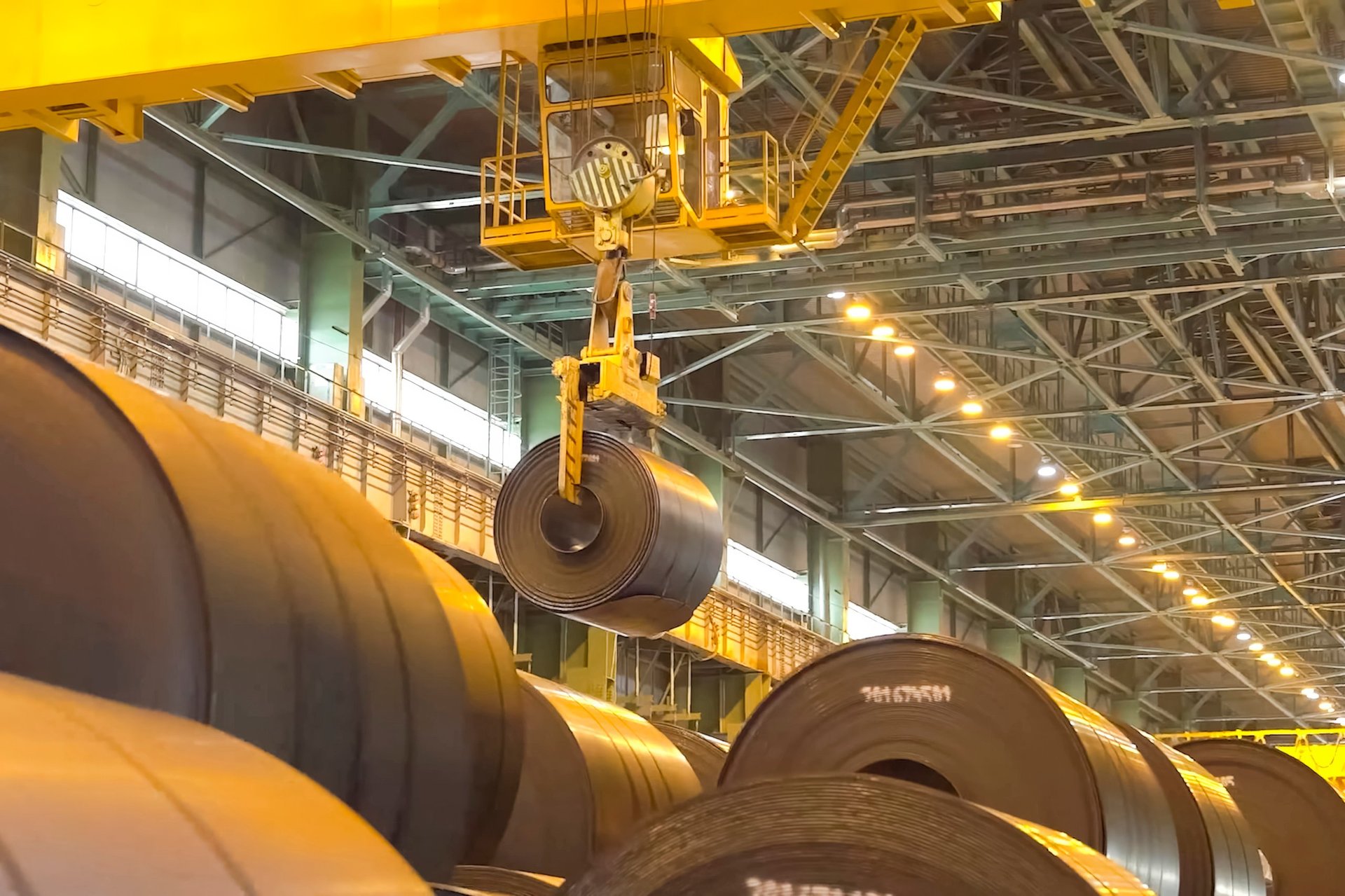
A worked stress-test on the arithmetic
Suppose a buyer knows only that a coil is about 1500 mm across, and asks what it weighs. An annulus needs the bore as well, so both figures have to be known before any area can be worked out — and even then the width is still missing. Mass comes from the annulus area multiplied by the strip width and the density, which is why an outer diameter on its own answers nothing. That is a statement about the arithmetic, not a worked mass figure for any particular coil.
| Quantity | How it is established |
|---|---|
| Inner diameter | Measured across the bore. A physical property of the coil — it cannot be adjusted later to suit a mandrel. |
| Outer diameter | Measured across the wound coil as delivered. Changes through the life of the coil as it is unwound. |
| Strip width & thickness | Measured on the strip, to the product specification's own dimensional provisions. |
| Coil mass | Weighed, and recorded on the packing list. The figure the lifting plan should be built from. |
| Estimated mass | Calculated during planning from nominal dimensions. Useful for sizing a lift, not for setting a limit against it. |
| Eye orientation | A packing decision stated on the order, not a measured dimension. |
Set the limit against the weighed figure
If a crane is rated to 8 t, a coil estimated at 7.6 t from nominal dimensions is not a comfortable lift — it is one packing-list reading away from being over. Give the equipment its true limit and let the offer come back with a weighed mass on it.
State the limit on the enquiryPacking & storage
Packing follows the orientation, and the orientation follows the gear
Packing, lifting and storage are one decision seen from three angles. Once the eye orientation is fixed, the banding pattern, the lifting method and the floor space all follow from it — which is why the orientation belongs on the enquiry rather than in a note after the order.
Eye to sky
The coil sits on its side face with the bore vertical. It stacks without rolling and is the usual orientation for C-hook, clamp and lifting-belt handling. It takes up the coil's outer diameter in floor area.
Eye to wall
The coil rests on its outer diameter with the bore horizontal, so it needs a cradle or a chock to stop it rolling. It is how a coil sits on a mandrel, and it is the orientation a decoiler usually wants.
| Point | What to settle |
|---|---|
| Stack height | How many coils can be stacked at the receiving site, given the outer diameter and the floor loading the slab was designed for. |
| Banding and edge protection | Whether the coil needs edge protection or additional banding for the number of handling operations it will see. |
| Corrosion protection | Whether storage is under cover or exposed, since a coil held outdoors needs more protection than one going straight onto a line. |
| Identification marking | Where the heat or lot marking has to sit so it can be read while the coil is still banded. |
| Handling count | How many times the coil will be lifted between despatch and the mandrel, because every lift is a chance to damage the edge or the wrap. |
| Delivery point | Whether the destination is a port, a yard or a line-side drop — the harder the final lift, the more the packing has to carry. |

Where the coil form is the wrong choice
If the receiving site has no mandrel, no coil car and nowhere to store an eye-to-sky stack, the handling problem may be better solved by the product form than by the coil size. Confirm the material and the form together before the dimensions are fixed.
Specifying it
Write the handling requirement onto the same enquiry as the material
Handling details are not a separate conversation from the steel specification. They travel on the same enquiry, because the packing, the loading plan and the coil size are all fixed from them — and re-opening any of them after the order is placed usually means the coil is handled twice.
| Input | What to state |
|---|---|
| Mandrel / inner diameter | The bore the line actually runs, including any sleeve or adapter range the mandrel uses. |
| Maximum outer diameter | The largest coil the crane, the racking and the access route will accept. |
| Maximum coil mass | The rating of the lifting gear and the floor loading — the limit, not a preferred figure. |
| Eye orientation | Eye to sky or eye to wall as required on delivery, stated rather than left to default. |
| Storage method | Stacked, cradled or racked, and whether under cover or exposed. |
| Re-orientation | Whether the coil has to be turned after arrival, and with what equipment. |
| Product standard, grade, dimensions | The material specification, the designation, and the strip width and thickness. |
| Quantity, destination, documents | Quantity basis, destination with named place or port, and the records the project expects. |
The constraint that cannot be changed later
Width, thickness, mass and packing can all be adjusted within limits to suit a receiving site. The inner diameter is the exception — it is set when the coil is wound, so a bore that does not suit the mandrel is not something the receiving team can solve on the floor. If you are unsure which mandrel the coil will run on, resolve that before the enquiry rather than after it.

Where the coil is actually going
If the coil is destined for a roofing or cladding line rather than a generic fabrication shop, that process usually imposes its own coil size and mandrel constraints — worth reading alongside the handling requirement.
Cladding and roofing coilVerification
Check the coil against the handling limits before it is lifted
Verification on this side of the order is about the packing list, the identification and the physical coil — not about the steel grade again. The checks below are the ones that decide whether the coil can be released to the line or has to be parked.
- Read the mass off the packing list firstThe weighed mass is what the lift is planned against. Check it against the gear rating before anything is unbanded — an estimated figure is a planning number, not a limit.
- Measure the bore before committing to the mandrelConfirm the inner diameter on the coil matches the mandrel it is going onto, including any adapter or sleeve in use. A mis-match found at the decoiler is a re-handling operation.
- Confirm the orientation matches the loadingCheck the coil is standing in the orientation the receiving area expects. If it is not, treat it as a planned re-orientation rather than an improvised one.
- Check identification while the coil is bandedGrade or designation, heat or lot marking and the coil number should be legible without breaking the banding. If they are not, resolve that before the coil leaves the unloading area.
- Inspect the wrap and edges for handling damageBanding integrity, edge protection and wrap condition are checked on receipt, because the number of lifts between despatch and the line is often more than the packing was planned for.
Fit to the receiving process
Handling constraints change when the line changes
The most common cause of a coil that no longer fits is not a supplier error — it is that the receiving site changed. A new decoiler takes a different bore. A re-arranged yard lowers the crane's effective limit. A second shift lifts the coil more times than the packing was planned for. The coil specification has to be re-checked whenever the handling equipment changes, not only when the steel does.
Kept deliberately open. Crane ratings, rack capacities, floor loading limits and packing declarations are site-specific. Nothing on this page states a figure for any particular installation — those are confirmed against your own equipment and the actual supply when the enquiry is reviewed.
Adjacent reading
Decisions that usually travel with the coil size
Use these when they answer a real handling or specification question. A neighbouring page is context for a decision — it is not evidence that two product forms, coil sizes or packing arrangements are interchangeable.
GCC shipment
Handling constraints change with the route, not just the destination
The coil specification stays the same across the region, but the number of times it is lifted, lashed and re-stacked changes with the route. Continue with the market that matches where the coil is going.
 United Arab EmiratesMandrel match and site receivingUAE coil deliveries are often received against a specific decoiler or roll-forming line. The mandrel inner diameter and the handling equipment limits are confirmed with the receiving site before the coil size is fixed on the order.Coil supply for United Arab Emirates
 Saudi ArabiaProject handling plansSaudi project supply runs on a defined handling and storage plan. Eye orientation, maximum coil mass and the packing method are agreed against the site's lifting equipment before a commercial offer is issued.Coil supply for Saudi Arabia
 QatarSubmittal and receiving alignmentQatar infrastructure and EPC supply prioritises technical submittal approval, so the coil dimensions, eye orientation and packing specification are agreed in writing before a quotation basis is fixed.Coil supply for Qatar
 KuwaitLifting gear compatibilityKuwait coil buyers tie the ordered coil size to the lifting gear and mandrel they actually run. Maximum outer diameter and mass are fixed early so the coil can be unloaded and unwound without re-handling.Coil supply for Kuwait
 BahrainCoastal storage and packingBahrain receiving conditions favour attention to packing and protection. Coil orientation, packing method and identification marking are coordinated to the actual delivery rather than to a generic description.Coil supply for Bahrain
 OmanPort handling and lashingOman coil movements route through port destinations, where the coil has to be lashed and lifted more than once. Eye orientation, mass and packing are harmonised to the vessel and terminal constraints before shipment documents are prepared.Coil supply for Oman
Customs treatment, conformity requirements and duty are confirmed for the actual shipment. They are not inferred from the destination country alone, and nothing on this page is a statement about a branch, warehouse or stock position in any of these markets.
Questions buyers ask
Steel coil inner diameter and handling — common questions
Each answer depends on the equipment at the receiving site and the coil actually offered. Where a question can only be settled against your own installation, the answer says so rather than offering a general figure.
Can coil weight be calculated from the outer diameter alone?
No. A coil is an annulus, so its mass depends on the outer diameter and the inner diameter together with the strip width, thickness and the density of the steel — and in a wound coil the layers do not sit perfectly tight against each other. That packing effect means even the full set of nominal dimensions gives an estimate rather than a measured weight. An outer diameter on its own fixes none of the other terms, so any figure derived from it alone would be unreliable. Treat the mass on the packing list as the record and any calculation as a cross-check.
What inner diameter does a standard uncoiler mandrel accept?
Mandrel sizes are not universal, and the acceptance range belongs to the machine, not to the coil. Common coil inner diameters are produced to suit particular mandrel families, but the only reliable check is against the specific mandrel on the line that will run the coil — including any expansion range, sleeve or adapter it uses. Give the mandrel or core bore that has to be matched when you enquire, and confirm it against the coil specification before the order is placed rather than at changeover.
What does eye to sky and eye to wall mean?
Eye to sky means the coil rests with its bore vertical, so the coil sits on its side face and the open eye points upward — the usual orientation for stacking and for C-hook or clamp handling. Eye to wall means the bore is horizontal, with the coil resting on its outer diameter and the eye facing sideways, which is how coils sit on a mandrel or in a cradle. Coils are normally supplied eye to sky unless the order states otherwise, because the two orientations need different lifting gear, different floor space and different lashing.
Which coil dimensions are measured and which are estimated?
Inner and outer diameter are measured, normally in millimetres across the bore and across the outside of the wound coil. Width and thickness are measured on the strip. Mass is the quantity most often estimated before despatch and confirmed on the packing list, because it depends on the actual wound condition rather than on nominal figures. When a handling limit is critical, ask which of the numbers on the offer are measured and which are calculated.
Can a coil be re-oriented after it has been packed?
Re-orienting a banded coil is a handling operation that has to be planned, not assumed. Turning a coil from eye to sky into eye to wall needs the right lifting gear and a clear area, and the banding is designed for the orientation it was packed in. If the receiving end needs a different orientation from the shipping one, say so on the enquiry — the packing and the loading plan are set on that basis, and changing it later usually means the coil is handled twice.
What handling details should an enquiry carry before a coil offer is firm?
The mandrel or inner diameter the line accepts, the maximum outer diameter and mass the lifting gear and floor can take, the eye orientation required for delivery, the storage method, and whether the coil needs to be re-oriented on site. Those points do not change the steel itself, but they change the packing, the loading plan and whether the coil can be received at all — so they belong on the enquiry rather than in a follow-up message.
Request a quote
Send the handling limits with the material requirement
Provide the mandrel bore, the maximum outer diameter and mass your equipment accepts, the eye orientation you need, and whether the coil will be re-oriented on site — alongside the product standard, grade, strip width, thickness, quantity, destination and any inspection documents the project requires.
What happens after you send it
- 1The handling constraints are checked against the coil sizes the requirement allows.
- 2Any conflict between the material specification and the equipment limits is identified and raised back to you.
- 3Packing, loading and delivery terms are formed on that basis, with the mass confirmed on the packing list.
Availability, origin, certification, lead time and freight are confirmed on quotation against current company data — nothing on this page should be read as a stock or price statement.
Monday – Saturday, 8.00 AM – 6.00 PM · Sunday closed
Receiving the coil on a different line than last time?
Mandrel sizes and mass limits differ between machines. State the limits you have now, and the technical review will check the coil size against them.
Noor Deira Steel Trading L.L.C. · Office 3303, Churchill Executive Tower, Business Bay, Dubai, United Arab Emirates