
Specify a cylinder counterface
Use the final bore drawing and actual seal supplier’s requirements.
Technical Reference
Specify the tube surface by function: a seal-running bore, a fitting contact, a forming surface and a corrosion-protection finish need different acceptance. Separate texture, treatment, cleanliness and coating requirements. Use the tool only to compare the same measured parameter and conditions with your own upper limit.
“Smooth”, “honed”, “polished” and “bright” are not complete measurement requirements. The tool does not convert Ra to Rz, recommend a universal finish or approve an interface.
Comparison Tool
Use the same parameter, unit, definition and measurement conditions for limit and result. This tool performs a single upper-limit comparison. It does not convert Ra to Rz, approve seal function, apply a sampling rule or assess an acceptance band.
No comparison prepared.
Comparison result
Enquiry Builder
Capture the decisions below, prepare a review summary and copy it to the tube RFQ. Keep the texture comparison with its exact measurement reference. Obtain the actual interface requirements and define treatment, cleanliness and preservation independently before order acceptance.
Complete the specification to prepare a review summary.
Prepared specification
Keep the texture comparison with its exact measurement reference. Obtain the actual interface requirements and define treatment, cleanliness and preservation independently before order acceptance. This page prepares the summary locally and does not send it anywhere; the destination RFQ owns contact collection and submission.
Method
Record parameter, units, upper limit or full acceptance band, standard and edition, profile/filter settings, evaluation length, measurement direction and locations. Use the drawing’s specified metrology framework; do not silently apply a legacy definition or an updated one. Confirm instrument suitability and uncertainty with the inspection owner.
It reports
It does not
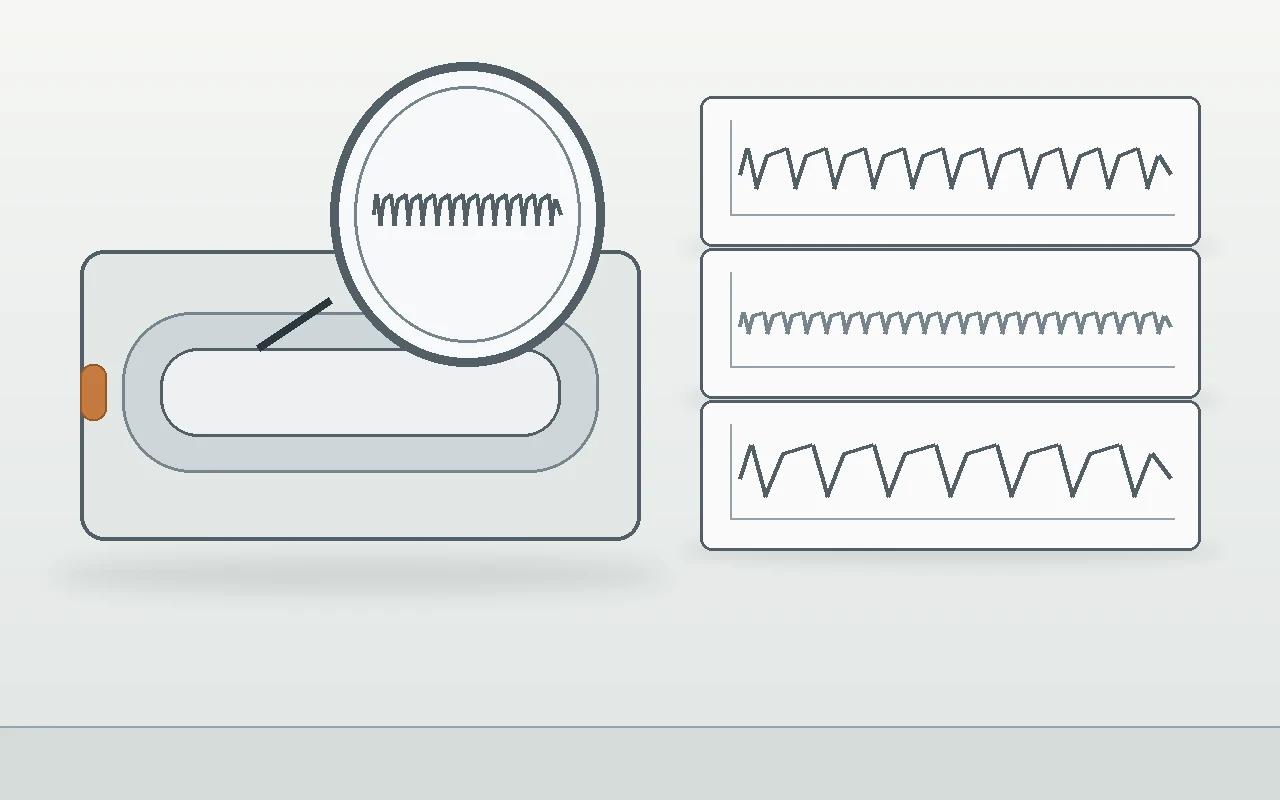
A roughness number is only meaningful inside the definition that produced it. The same surface, measured on a different parameter, filter, evaluation length or direction, returns a different figure — and none of those figures is wrong. Comparing two of them as though they were the same measurement is the error this tool refuses to make. That is why an unresolved definition returns a not-comparable state rather than a number: a result that cannot be used is worse than no result, because it invites a decision. The tool checks only measured value ≤ entered upper limit, after you confirm the definitions and conditions match.
Processes are not measurements
Passivation, pickling, polishing, honing and bright annealing describe different treatments or processes; none is a substitute for a complete texture measurement or cleanliness requirement.
Worked Examples
For an illustrative buyer-defined Ra upper limit of 0.80 µm, a comparable Ra reading of 0.65 µm is below the entered limit. This is arithmetic, not a recommended tube finish or a conformity decision.
Comparable and below
An Ra limit of 0.80 µm with a comparable Ra reading of 0.65 µm is below the entered limit. Sampling, uncertainty and the acceptance rule still apply.
Not comparable
A measured Rz of 4.0 µm cannot be compared with that Ra limit. Do not convert it using a fixed ratio. Obtain the specified parameter under matching conditions.
These figures are illustrative. The values above are buyer-defined examples for demonstrating arithmetic, not standard texture requirements. A seal-running bore may require additional texture and geometry criteria from its actual seal supplier.
Route Decision
Three bracket questions separate the routes before a texture limit is applied. Each one changes which surface requirements the item actually carries.
| Decision | Why it matters here | Before you enquire |
|---|---|---|
| Seal-running bore | Surface function depends on the chosen seal and operating conditions. | Use the seal supplier’s complete counterface requirements. |
| Fitting contact | The connection may restrict surface defects and tubing condition. | Use the fitting manufacturer’s applicable tube requirements. |
| Protective or cosmetic finish | Appearance and treatment do not prove texture or cleanliness. | Specify each required acceptance separately. |
Not sure which product family the supply belongs to? Explore the full steel-tubes range. It sets out the types, standards and enquiry path for every route named here.

Use the final bore drawing and actual seal supplier’s requirements.
Separate zinc-coating conformity from the substrate’s texture and dimensional fit.
Acceptance Basis
“Smooth”, “honed”, “polished” and “bright” are not complete measurement requirements. The tool does not convert Ra to Rz, recommend a universal finish or approve an interface.
| Specification decision | Applicability and limit | Evidence to request | RFQ action |
|---|---|---|---|
| Texture | Parameter and measurement conditions control comparability. | Agreed standard edition, filter/evaluation settings and measurements. | Name parameter, units and acceptance rule. |
| Treatment | Chemical or thermal process names do not state a measured roughness. | Process specification and required verification record. | Define pickling, passivation, annealing or other treatment as applicable. |
| Cleanliness | Particles, residue and moisture need their own criteria. | Agreed cleaning and verification method. | State internal condition and post-cutting requirements. |
| Coating and preservation | Coating coverage and transport protection have separate purposes. | Coating inspection and packing/preservation plan. | Define delivered surfaces and protection period. |
The left-hand column is what the order has to name. Use the texture comparison and enquiry builder to turn these decisions into an enquiry the commercial department can answer line by line.
Document Package
Match every reported texture result to the same parameter definition and method as the drawing. Record instrument, locations, direction and conditions. Keep chemical treatment and cleaning records separate; a photograph cannot establish measured texture.
| Control | What to examine | When and limits | Next action |
|---|---|---|---|
| Texture | Agreed standard edition, filter/evaluation settings and measurements. | Before material acceptance; confirm feasibility and cost at quotation. | Name parameter, units and acceptance rule. |
| Treatment | Process specification and required verification record. | Before material acceptance; confirm feasibility and cost at quotation. | Define pickling, passivation, annealing or other treatment as applicable. |
| Cleanliness | Agreed cleaning and verification method. | Before material acceptance; confirm feasibility and cost at quotation. | State internal condition and post-cutting requirements. |
| Heat and item identity | Mill test certificate linked to heat markings and packing list. | Before release and again on receipt; a sample certificate is not evidence for the shipped heat. | Request traceability through cutting, bundling and delivery. |
A texture figure with no parameter, filter or evaluation length beside it cannot be reviewed, and a photograph of a surface — however good it looks — cannot establish measured texture.

Remaining Decisions
Transfer the surface requirement into the actual interface and tube order, with the delivered processing stage stated.
Texture acceptance does not establish bore size, straightness or ovality.
Match the internal condition and fitting contact requirements to the actual circuit.
Do not treat the drawn route as a complete seal-surface specification.
Coordinate tube export documents — align tube identification, bundle protection and transport documents with the named delivery place before dispatch.
GCC Destination
Use the destination to close the quotation scope, then confirm feasibility and commercial terms in writing. Country flags identify the destination; quotation must confirm the supply route, origin and availability for this order.
Protect the accepted tube surfaces and sealed internal condition through destination receipt. Identify the emirate, fabricator or site address and unloading restrictions; distinguish a domestic handover from an import leg.
Protect the accepted tube surfaces and sealed internal condition through destination receipt. Name the consignee, importer and final site; ask who confirms product classification and border documentation before dispatch.
Protect the accepted tube surfaces and sealed internal condition through destination receipt. State the nominated receiving point and project document approver; align certificate review with the required arrival window.
Protect the accepted tube surfaces and sealed internal condition through destination receipt. Specify the actual port, border point or inland site requested; separate the entry leg from onward transport and unloading.
Protect the accepted tube surfaces and sealed internal condition through destination receipt. Identify the contractor or fabrication yard receiving the tubes; agree import-document responsibility and the named delivery place.
Protect the accepted tube surfaces and sealed internal condition through destination receipt. Confirm whether the order is for local consumption or onward shipment; name the consignee and agree who handles each transport leg.
Expert Insight
Mitutoyo describes Ra and Rz as different profile parameters with defined measurement conditions. A fixed conversion would discard information about the profile.
Buyer implication: Request the specified parameter under matching conditions rather than converting a supplier’s different result.
Method: Review of the instrument manufacturer’s parameter and measurement guidance. Applicability: Profile texture measurement concepts. Limit: The referenced guide includes legacy standards; use the drawing’s specified framework and edition rather than silently applying its settings.
Mitutoyo — Surface Roughness Measurement · Information reviewed 2026-10-16.
Why Control It
Each of these is a field on the order, and each one exists so a surface result can be shown against the requirement rather than argued after the material is released.
Agreed standard edition, filter/evaluation settings and measurements.
Name parameter, units and acceptance rule.
Process specification and required verification record.
Define pickling, passivation, annealing or other treatment as applicable.
Agreed cleaning and verification method.
State internal condition and post-cutting requirements.
From Specification To Receipt
Four stages, each with an owner. An item that is still open at any stage becomes a decision made by whoever receives the material rather than by whoever specified it.
| Stage and owner | Required input | Evidence or output | Risk and next action |
|---|---|---|---|
| Engineering releaseBuyer’s design authority | Interface owner releases surface function and measurable acceptance. | Approved specification and drawing revision | Unapproved substitution can change the design basis. Close the item before proceeding. |
| Offer reviewBuyer and quotation team | Buyer agrees process scope, method and preservation. | Written technical exceptions and commercial scope | An unlisted exception can survive into the purchase order. Close the item before proceeding. |
| Material releaseMill, inspector and buyer as agreed | Inspector verifies matching texture and separate treatment/cleaning records. | Accepted documents linked to the order items | Missing heat identity can make an otherwise correct tube unacceptable. Close the item before proceeding. |
| Receipt and reconciliationReceiving team | Receiver protects surfaces until the approved next operation. | Delivery record, item count and discrepancy record | Record any mismatch before the material is incorporated into work. Close the item before proceeding. |
Common Questions
No universal conversion is used here. Obtain the specified parameter measured under the required conditions.
No. Specify cleaning criteria and verification separately from the finishing process or appearance.
It is not a complete measured texture requirement. Provide parameter, units and method where texture matters.
No. Apply the actual seal supplier’s full texture, geometry and service requirements plus the agreed acceptance rule.
The tool returns a not-comparable state. Resolve parameter definition, filter, evaluation and method before comparing.
Enquiry Handoff
Keep the texture comparison with its exact measurement reference. Obtain the actual interface requirements and define treatment, cleanliness and preservation independently before order acceptance. Include the completed fields and the controlling drawing revision so exceptions can be returned against the right requirement.
Prepare and copy the summary above, then open the steel-tubes RFQ and paste it into the requirement field. Add your name, company and reply email on that form. Supporting drawings can be shared through the destination’s verified contact process.
This page prepares your enquiry locally. Opening the RFQ does not submit it. A submission is complete only when the receiving form returns a genuine acknowledgement.
sales@noordeirasteel.ae · +971 56 398 0860 · Business Bay, Dubai





