
Confirmed at quotation
The material record
The certificate that ties the delivered pipe to its plate and its welds. On a plate-built pipe this is what makes the base material traceable rather than asserted.
EF-welded pipe · Moderate-temperature pressure service
On a pressure-service order the expensive mistakes are not in the pipe — they are in the paperwork. A class left unnamed, a heat treatment not evidenced, an NDT scope assumed rather than stated. This page is built around one job: closing those gaps before the offer is accepted, so the certificate that arrives describes the pipe you actually ordered.
Price on request. No pressure rating is implied by this standard's name — the allowable pressure of your line comes from a design calculation, and the code checks stay with your project.
Class named
The ordered condition — treatment, extras and tests.
Plate stated
The base plate the pipe is fabricated from.
NDT scoped
The examination your project expects to see.
Code checks
Design and joint acceptance stay with your project.
Documentation gap checker
Six inputs an A672 pressure-service order has to carry, and the evidence that should sit behind each. Tick the ones your order already states; the checker reports what is still open. It reports gaps — it does not choose a class for you, does not imply a pressure rating and does not approve a code check.
6 of 6 inputs still open. Base plate material, Class, Heat treatment, NDT scope, Dimensions, Code checks — each one is a gap that the certificate cannot close later if the order never stated it.
Take it to the RFQGap record
The open and stated inputs as you have marked them. Copy it into a specification review or the enquiry below.
ASTM A672 steel pipe — documentation gap check

Inputs stated (0/6):
  (none marked yet)

Inputs still open (6/6):
  [ ] Base plate material — The underlying plate specification the pipe is fabricated from is written onto the order.
  [ ] Class — The class is named, so the heat treatment and supplementary requirements are fixed rather than implied.
  [ ] Heat treatment — The heat treatment the pipe receives is stated and traceable to the class.
  [ ] NDT scope — The non-destructive examination your project expects is written onto the order.
  [ ] Dimensions — Outside diameter, wall thickness and length are stated — they feed the pressure design, they do not replace it.
  [ ] Code checks — The construction code governing the welded joint and the design check are identified on the project side.

6 inputs still open — close these before the pipe is ordered against A672.

Supplier: Noor Deira Steel Trading L.L.C. — sales@noordeirasteel.ae — +971 56 398 0860
Governing edition, construction code and acceptance criteria to be confirmed at quotation.
The checker reports gaps — it does not fill them. Which class your line needs is settled by the specification read with your design basis; whether the welded joint is acceptable is a construction-code call owned by your fabricator and inspector; what pressure the line may carry is a design calculation. Use the checker to be certain the order states every input those decisions depend on.
What A672 governs
The specification is written as a base plate plus a class, and on a pressure-service order that two-part structure is what you are actually buying. Read it as one word and the offer looks complete while the treatment and the examination behind it stay unstated.
Inside the specification
Outside it — and often assumed
Why a pressure-service buyer reads the class, not the name
On a pressure-service line the pipe is only as good as the evidence behind it. The base plate names the material; the class names what was done to it and what was checked. An offer that reads "A672" and stops there has told you the standard and nothing about the treatment or the inspection — which is exactly the pair of things your inspector will ask for. Two suppliers can both quote "A672 pipe" and be offering genuinely different deliverables, because the class on each is different.
The pressure-service framing sharpens this further. Because the pipe is destined for a line with a design temperature and a design pressure, every input that feeds that calculation — the dimensions, the treatment, the examination — has to be fixed on the order rather than left to a supply default. That is not a formality: it is the difference between a certificate that supports the design and one that merely accompanies the pipe.
We publish no allowable stress, wall tolerance, treatment temperature or pressure rating for this standard. Each follows the governing edition read with your design basis, and is confirmed against the requirement you state.
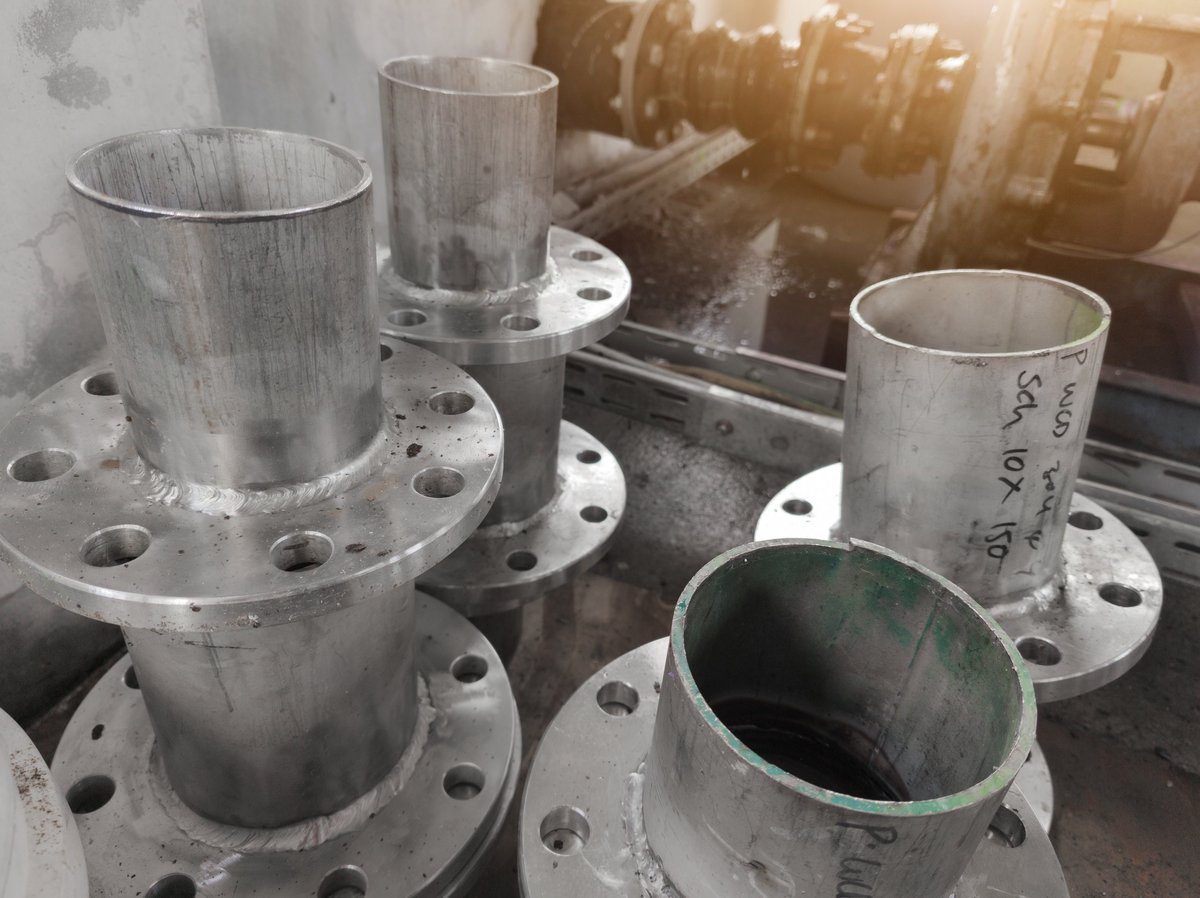
Where A672 stops
A672 is one specification among several for welded pipe, and the differences between them are differences of scope, not of quality. Treating the family as a ladder — with A672 above or below its neighbours — is how a specification gets chosen for the wrong reason.
A671
The same electric-fusion-welded family, written for lower-temperature and atmospheric service. It shares the base-plate-plus-class structure and is confused with A672 constantly, because the welding looks identical — only the service band it is written for differs.
Same process, different service band — not a ranking.
A672 — this page
The moderate-temperature pressure-service specification for electric-fusion-welded pipe. It is reached for when the duty sits in that band and the pipe is fabricated from plate — the service scope, not seniority, is what places it here.
Chosen for its service scope, never for being "stronger".
A691
Another high-temperature welded-pipe specification in the same wider family, with its own scope. It is not an upgrade path from A672 and not a substitute for it — the applicable standard follows from the service and the design code, not from an assumed order of importance.
A different scope entirely — the choice is your design basis's.

The adjacent standards worth checking
Before the standard is fixed, the comparison that catches most mistakes is against the seamless and general-service carbon specifications — they are often specified where a welded pressure-service standard was actually intended, or the reverse. Those are the references that keep an A672 requirement from being raised on the wrong basis.
No equivalence or superiority between A672, A671 and A691 is implied anywhere on this page, and none should be read into a quotation. Confirm the governing standard with your design authority before the pipe is ordered.
Evidence and records
On a pressure-service pipe the certificate is not an afterthought — it is the document your inspector works from. The distinction that matters is between the provisions the specification carries and the supplementary requirements your project adds on top; one is a floor, the other is your actual requirement.
The material record
The certificate that ties the delivered pipe to its plate and its welds. On a plate-built pipe this is what makes the base material traceable rather than asserted.
The treatment record
Heat treatment is not evidenced by the class name alone — the order must carry it and the record must reflect it, or the pipe's condition is unproven.
The examination record
The NDT scope your project expects, demonstrated by the records. An assumed scope that was never written onto the order cannot be retrofitted into the certificate.
A reasonable fit when
Revisit the basis when
On a welded pressure-service pipe the records are part of what you are buying, not paperwork trailing behind it. If the product form is still open, start from the steel pipe supply reference — the welding route and the records that follow from it depend on the form you choose, not the other way round.
GCC markets
Destination changes the commercial and documentary side of the order, not the acceptance basis. Choose the market to see what each destination expects before the consignment is released.
The hub for the other pipe specifications. If the standard itself is still being chosen, settle it against your service band before the pipe is ordered — the ordering discipline is the same, but the acceptance criteria are not.

Project coordination and release documents.
Confirm the base plate, class, heat treatment, NDT scope and dimensions against the project requirement, then plan release to site, fabricator or stockist.

Specification alignment and import papers.
State the class, governing edition, construction code and ordered examination alongside the delivery base so the offer matches the requirement.

Requirement and delivery window.
Confirm dimensions, wall thickness, quantity and delivery window so the documentation plan stays aligned to the order.

Delivery basis and documentation.
Give the delivery point and Incoterm so the certificate and release paperwork can be arranged against the order.

Contract terms and certificates.
Settle the record set and the plate traceability before quotation — it is the field most often left open on a pressure-service enquiry.

Energy and process supply.
Provide the destination, the required records and a delivery date so the offer can be fixed against your inputs.
These market pages are procurement destinations, not a claim of premises in each country. Supply is coordinated from Dubai and delivered against the destination and delivery date you state.
Compare and verify
A welded pressure-service standard is frequently specified where a seamless or general-service one was meant, and the neighbouring references carry the decision either way. These are the pages worth checking — together with the ones that take the standard-level decision down to a base material.
The hub for the other pipe specifications, so you can compare scope before committing to one.
Useful when the standard itself is still being chosen.
How ASTM steel designations are organised — the wider reference the base plate sits within.
Start here when the plate designation is still open.
The product form to check when the requirement is tubing rather than pipe — a different dimensional basis.
Useful when pipe and tubing could be confused.
A seamless carbon specification, often specified where a welded pressure-service pipe was actually intended.
Check whether your product form is welded or seamless.
Comparing across a standard family
A welded-pipe designation is not an interchangeable part for a seamless one, and within the welded family the service band is not a quality tier — A671, A672 and A691 are three scopes, not three grades of one product. Moving between them changes the product form, the acceptance basis and the records the pipe arrives with, so it has to be re-confirmed against your design basis rather than carried across from a designation on an old requisition.
Where the requirement is a steel tube rather than a pipe, check the product form first — the dimensional and standard basis changes with it, and so does what the record has to demonstrate.
Read the governing standard
The base plate references, the classes the specification lists and the marking requirements all sit inside the standard. Read it alongside your project specification and your pressure-design code rather than relying on the designation alone — the documents answer different questions, and the standard only answers its own.
A pressure-service standard matters commercially at the destination as well as in the specification — the UAE market page sets out how project coordination and release documents are handled locally, which is worth reading before you fix the delivery basis.
From gap check to offer
The gap checker settles which inputs belong to the material order, the welding and the design code. This is the sequence that turns a complete order into a comparable offer, and the point at which each input is actually used.
Service band established
Design authority
The duty is placed in moderate-temperature pressure service — the scope A672 is written for.
If the duty sits in a different band, another specification applies instead.
Base plate named
Specification author
The base plate specification the pipe is fabricated from is stated on the requirement.
Left open, the base material becomes whoever supplies the pipe's choice.
Class fixed
Buyer and commercial desk
The class is named, with the heat treatment and supplementary requirements it assembles.
The class carries the ordered condition — unstated, those provisions are unfixed.
Treatment and NDT agreed
Project team
The heat treatment and the examination scope are written onto the order before it is placed.
An assumed scope cannot be retrofitted into the certificate after delivery.
Design and code checks scheduled
Engineering team
The pressure design and the construction-code review of the joint are arranged on the project side.
The material standard is not a pressure rating — the gap must be closed by design.
Offer with commercial terms
Commercial desk
Availability, price, quantity and delivery confirmed on request.
Commercial variables stay open until you supply them.
Send the completed gap check and the desk comes back against your requirement rather than a standard package. Reachable Monday to Saturday, 8.00 AM to 6.00 PM Gulf time.
Request a QuoteStraight answers
These are the ones the desk fields most often from pressure-service buyers, answered the way they are answered there — including the parts that make the process slower.
That question cannot be answered from the standard, and any table on a supply page that appears to answer it should be treated with suspicion. A672 governs what the pipe is made of, how it is welded and what is tested; the allowable pressure of your line comes from a design calculation using the dimensions, the design temperature and the code your project is built to. The designation does not imply a rating. Give us the duty and the dimensions your design requires, and we supply the pipe that satisfies them — the design itself is your engineer's.
No, and on a pressure-service order this is the assumption that costs the most. A672 is a base plate plus a class, and the class is where the ordered condition lives — the heat treatment, the supplementary requirements and the testing the pipe carries. Two offers can both read A672 and describe different pipes, because the class differs. When you compare quotations, compare the full designation. If an offer does not state the class, the class has not been fixed, and the deliverable is still open.
They are not ranked against each other — they are three scopes in the same wider welded-pipe family, and the applicable one follows from your service and your design code. A671 is written for lower-temperature and atmospheric service; A672 for moderate-temperature pressure service; A691 for its own high-temperature scope. Choosing between them is a decision about the duty, not a judgement about quality. If your design basis names one of the others, that is the standard to order against, and we will say so rather than steering you to what is easiest to supply.
There is no single answer we would hand you, because the examination an order carries is assembled from the standard's provisions plus the supplementary requirements your project adds — and both are confirmed against what the order states. That is exactly why the gap checker asks you to mark the NDT scope rather than reading one off a table. Tell us what your project expects the certificate to demonstrate, and the desk confirms the scope against it rather than assuming one.
That is a materials decision, and we will not answer it with a plate recommendation from a supply page. The base plate the pipe is fabricated from is a design and materials choice that follows from your service, your design basis and the properties your project relies on. What we can do is supply the pipe built on the plate your specification names, under the class your order states, with the records it requires. The selection is yours; the supply is ours.
We do not publish stock positions on this page, because a figure written here would be stale by the time it mattered, and availability varies with base plate, class, diameter, wall thickness and examination scope. It is confirmed against your stated basis, quantity and required date when the enquiry reaches the desk. That is the honest sequence — the answer you plan around is the one given for your order.
Frequently asked questions
Five questions pressure-service buyers raise most often, answered without deferring the technical position to the quotation stage.
The class is the part of the designation that carries the ordered condition — it is the label under which the heat treatment, the supplementary requirements and the testing your order must carry are assembled. Two pipes can be built from the same base plate and still be different deliverables once the class differs. That is why a requisition reading only 'A672 pipe' is not yet an order: it names the standard and leaves the class, which is where the treatment and the inspection provisions actually live. The class belongs on the purchase order, stated, not chosen silently by whoever supplies the pipe.
They are two specifications for two different temperature services, and both describe electric-fusion-welded pipe — which is precisely why they get confused. A671 is written for lower-temperature and atmospheric service; A672 is the moderate-temperature pressure-service specification. So the difference is not the welding and it is not a quality ranking: it is the service the pipe is qualified against. Which one applies follows from your design temperature and duty, and that decision belongs to your design authority. We quote the standard your specification names, and if that is A671 rather than A672, we say so.
No, and no table on a supplier's page can either. A material specification governs what the pipe is made of, how it is welded and what is tested — it is not a pressure rating. The allowable pressure of your line comes from a pressure-design calculation using the dimensions, the design temperature and the code your project is built to, ASME or equivalent. The designation A672 does not imply a rating, and treating a standard's name as a pressure figure is the error this page is written to prevent. The design calculation is your engineer's; the pipe that satisfies it is ours to supply.
The records an A672 order carries are agreed when it is placed, not assumed from the standard's name. The material test certificate ties the pipe to its plate and its welds; the heat treatment is evidenced; the non-destructive examination scope demonstrates what your project expects to see. What the specification provides for is one layer, and the supplementary requirements your order adds are another — the two are not the same and the second is yours to state. Naming the documentation on the enquiry is how the offer you accept and the certificate that arrives describe the same pipe.
No — it is one specification in a family, and it is not a blanket answer for welded pipe in pressure service. A672 covers moderate-temperature pressure service in electric-fusion-welded pipe; a different service band, a different welding route or a different product form each points somewhere else, and the variation belongs to the material standard, not to product quality. Which one fits is a function of your service conditions and the code your project uses. Tell us the design temperature, the duty and the specification you are working to, and the desk confirms the offer against that basis rather than steering you to whatever is easiest to supply.
Still settling the basis?
Send the enquiry with what you have stated and flag what is still open. The desk will tell you which inputs it needs before it can price, rather than returning a number built on assumptions.
Noor Deira Steel Trading L.L.C.
Office 3303, Churchill Executive Tower, Business Bay, Dubai, United Arab Emirates · Monday to Saturday, 8.00 AM to 6.00 PM, Sunday closed.
Request a quote
Close the inputs as far as your project allows and send the check with your requirement. The commercial desk confirms availability, price and the documentation scope from what you state — price on request.
What an A672 enquiry needs
The base plate specification the pipe is fabricated from
The class the order is placed against
The design temperature and the service band it sits in
The governing edition of the material specification
Outside diameter, wall thickness and length
The heat treatment and the NDT scope your project expects
The pressure-design code governing the line
Quantity, delivery point and required date
Prefer to talk it through?