
Technical Reference · Steel Pipe Weight
Steel Pipe Weight Chart
Use the weight chart for estimating and logistics only after selecting the correct dimensional standard, NPS/OD, and wall/schedule. Weight results must state the calculation/tabulation basis and remain separate from actual shipment mass, tolerances, coating mass, packaging, and commercial quantity verification.
- NPS / OD / wall
- Length × piece count
- Standard & edition
- Unit system
- Estimate ≠ shipment mass
RFQ-readiness: a steel pipe order becomes quotable when the standard/edition, NPS/OD, wall/schedule, quantity and destination are explicit. Use the Weight Estimator to build the nominal mass basis, then transfer it to the RFQ — and verify material, grade and service suitability as separate gates.
Price on request — mass basis, quantity, schedule, material and grade confirmed from the full verified specification
Interactive decision tool
Steel Pipe Weight Estimator
Select the dimensional standard and the nominal size, supply the wall and the length/count, and the estimator returns a nominal bare-pipe mass on a disclosed basis — an estimate for quantity and logistics, never a shipment figure — with a copyable line for RFQ.
Verification signal
Governing dimensional standard required
No outside diameter or weight is presented without a stated dimensional standard and edition. Select the governing standard — for example ASME B36.10 — so the estimator identifies the dimensional reference the OD answers to. The weight result is an estimating basis only: it never establishes pressure rating, wall, grade or service suitability.
Scope boundary
The estimator returns a nominal bare-pipe mass for estimating and logistics. It does not include coating, end protection, tolerance, packaging or actual shipment mass; it does not calculate pressure capability or derive wall from schedule; and it does not imply material, grade or service suitability. Unsupported sizes and invalid OD/wall pairs force a verify-against-standard path rather than a guessed number.
Copyable logistics / RFQ summary
The nominal mass basis and qualified fields to carry into the RFQ. All assumptions are explicit.
| Field | Value |
|---|---|
| Product / entity | Steel Pipe (Weight) |
| Manufacturing route | to confirm (seamless / welded) |
| Material | — |
| Standard and edition | — |
| Grade / PSL / type | — |
| NPS / DN / OD | — |
| Schedule or wall thickness | — |
| Length / end finish | — |
| Nominal mass basis | nominal, per unit basis |
| Service / design conditions | service suitability verified separately |
| Coating / lining / finish | to confirm |
| Testing / inspection | dimensional / tolerance / weigh check + MTC |
| Document / MTC requirements | MTC + dimensional / weigh report |
| Quantity / unit | — |
| Packing | as quoted |
| Destination country / city / port or named place | — |
| Incoterm | to confirm |
| Requested delivery date | — |
Method & data conditions
How this chart derives its weight basis
Every value is presented under a stated dimensional standard, unit system and density assumption, with source, method, applicability and limits made explicit.
Nominal mass, transparently derived. The unit mass shown is computed from the stated OD and wall (annular cross-section) at a disclosed nominal density, or read from a verified dimensional dataset. Every value names its basis — it is an estimate for quantity and logistics, not a shipment weighing.
Unit system coherence. Inch-pound and metric are kept coherent: OD and wall share one unit system in a calculation. kg/m, kg/ft and lb/ft conversions are offered but always labelled, so no false precision is created by mixing units.
Estimate vs actual shipment mass. The computed mass excludes coating, end protection, tolerance, packaging and any scales/tally against the actual shipment. Commercial quantity verification is a separate step reconciled to the mill ticket and the weigh report.
Assumptions and limits. Wall must be supplied or confirmed (a schedule name alone does not fix wall without the schedule table), and the OD/wall pair must be coherent. The estimator does not derive pressure rating, wall from schedule, or material chemistry.
Source and revision
| Reference | Status | RFQ action |
|---|---|---|
| ASME B36.10 — Welded and Seamless Wrought Steel Pipe | Source of the nominal OD subset; edition to be confirmed at quotation | Confirm edition + stated standard |
| Nominal steel density (7850 kg/m³) and wall | Disclosed assumption; wall confirmed against the schedule table / MTC | Confirm wall + density basis |
| Project / owner dimensional requirement | May override a chart value for a named project | State project standard + edition |
| Mill test certificate / weigh report | Purchased OD, wall, tolerance and shipment mass per shipped heat | Request MTC + dimensional / weigh report |

The marking, end-condition and measurement inspection shown is part of confirming the purchased OD, wall and length against the standard, the mill certificate and the weigh report.
Worked examples
From input to a verified nominal mass basis
Example 1 — NPS 10, wall stated
Input: NPS 10, wall 9.27 mm, length 6 m × 20 pcs, metric, ASME B36.10.
Method: NPS 10 fixes a nominal OD of 273.1 mm; the annular cross-section with a 9.27 mm wall at 7850 kg/m³ gives a nominal unit mass of about 60.3 kg/m.
Interpretation: 6 m × 20 pcs ≈ 7.2 t nominal bare-pipe mass. This is an estimating and logistics figure — it excludes coating, tolerance, packaging and any actual shipment takeoff.
Decision impact: The buyer can use the mass for freight, handling and quantity planning and carries the wall into the RFQ. 10 inch steel pipe turns the dimension into a size decision.
Example 2 — size outside the subset
Input: NPS 5, wall 6 mm, inch-pound, ASME B36.10.
Method: 5 is not in this page’s reference subset, so no OD or mass is read off a partial chart.
Verification step: The OD and wall must be confirmed against the printed standard/edition. The RFQ carries NPS 5, the stated wall and a pending-verification note rather than a guessed mass.

Worked example table — NPS 10, 273.1 mm OD, wall 9.27 mm
| Step | Value | RFQ field |
|---|---|---|
| Nominal OD (metric) | 273.1 mm (NPS 10) | NPS / DN / OD |
| Wall thickness | 9.27 mm (supplied / confirmed) | Schedule or wall thickness |
| Unit mass (nominal) | ≈ 60.3 kg/m at 7850 kg/m³ | Nominal mass basis |
| Piece & total (bare) | ≈ 0.36 t/piece · ≈ 7.2 t / 20 pcs | Length / quantity |
| Verification | Edition, wall tolerance, MTC + weigh report | Document / inspection |
Standards · walls · size
The nominal OD and wall basis for weight
Nominal outside diameters referenced to ASME B36.10, combined with a user-supplied wall to produce a nominal bare-pipe mass. Every value is an estimating basis under the stated standard and edition, confirmed at quotation — it never establishes material, pressure or service suitability by itself.
Dimensions control the mass basis
The unit weight is set by the outside diameter and the wall under the governing standard and edition. Tolerance limits are set by that standard — confirm the permitted tolerance band on the actual size against the printed document, and note that the wall tolerance moves the weight within a small band.
Schedule is not pressure, and not weight alone
Schedule refers to a nominal wall series in the standard. Two pipes of the same NPS and different schedule share an OD but differ in wall and weight. Never assume a fixed weight for a size without the wall; schedule alone does not set pressure capability either.
Route, grade and coating are separate
Weight does not identify material, grade, route or coating. Seamless and welded pipes can share a size and nominal weight yet differ in material, grade, test obligation and any coating mass. Keep grade/PSL type, route and any finish explicit in the RFQ.
Verify at quotation
Every value that matters — OD, wall, length, quantity — is confirmed at order against the standard/edition and the mill certificate. This page builds the nominal basis; the RFQ carries it for verification and the shipment is reconciled by weigh ticket.
Core reference table — nominal OD by NPS (ASME B36.10)
Applicability: nominal outside diameters for welded and seamless wrought steel pipe in inch-pound (with millimetre equivalent). Limitation: a dimensional value only — the weight follows the wall, which is confirmed separately. Verify the edition and the tolerance band at quotation. RFQ field: NPS/DN/OD + Schedule or wall thickness.
| NPS | Nominal OD (in) | Nominal OD (mm) | RFQ action |
|---|---|---|---|
| 1/2 | 0.840 | 21.3 | Confirm edition + wall |
| 3/4 | 1.050 | 26.7 | Confirm edition + wall |
| 1 | 1.315 | 33.4 | Confirm edition + wall |
| 1-1/4 | 1.660 | 42.2 | Confirm edition + wall |
| 1-1/2 | 1.900 | 48.3 | Confirm edition + wall |
| 2 | 2.375 | 60.3 | Confirm edition + wall |
| 2-1/2 | 2.875 | 73.0 | Confirm edition + wall |
| 3 | 3.500 | 88.9 | Confirm edition + wall |
| 4 | 4.500 | 114.3 | Confirm edition + wall |
| 6 | 6.625 | 168.3 | Confirm edition + wall |
| 8 | 8.625 | 219.1 | Confirm edition + wall |
| 10 | 10.750 | 273.1 | Confirm edition + wall |
| 12 | 12.750 | 323.9 | Confirm edition + wall |
| 14 | 14.000 | 355.6 | Confirm edition + wall |
| 16 | 16.000 | 406.4 | Confirm edition + wall |
| 18 | 18.000 | 457.2 | Confirm edition + wall |
| 20 | 20.000 | 508.0 | Confirm edition + wall |
| 24 | 24.000 | 609.6 | Confirm edition + wall |
Conversion and tolerance context
Coherent unit conversions and an evidence warning: the mass basis uses one stated unit system and a disclosed density. Tolerances on the wall move the nominal mass only within a small band and are set by the standard; they are never added to the estimate as if they were shipment mass.
| Basis | Value / method | Evidence warning | RFQ field |
|---|---|---|---|
| Unit mass | Computed from OD + wall at 7850 kg/m³ (kg/m) | Nominal — verify wall and density basis | Nominal mass basis |
| Unit conversions | kg/m ⇄ kg/ft ⇄ lb/ft, labelled | Keep one unit system per calculation | Unit system |
| Tolerance | Wall tolerance band per the standard | Never added to the estimate as shipment mass | Inspection / document |
Verify scope before committing to a grade or route
The mass basis does not pick the grade. Confirm the product-standard scope and ordering fields — API 5L and ASTM A106 — before committing. Matching dimensions alone never establish material, grade, pressure rating or service suitability.
Verification & misuse controls
Common mass errors and when review is required
Input error — scheduling without a wall
A schedule name alone does not give a weight because it does not fix the wall without the standard’s schedule table. Enter or confirm the wall before converting length to mass.
Mixing unit systems
A millimetre wall with an inch OD (or a feet length with a metre basis) without stating both produces a false precision and an invalid mass. Keep one stated unit system per calculation.
Estimate vs actual shipment mass
The computed mass excludes coating, end protection, tolerance, packaging and any tally against the actual shipment. Use it for estimating and logistics, never as the invoiced quantity without a weigh reconciliation.
Uncertainty — unverified OD/wall pair
If the size is not in an authoritative reference and edition, or the wall is not confirmed, treat the mass as unverified. Request the mill certificate and a dimensional/tolerance check rather than reading a weight off a partial chart.
Engineering review boundary
Where a mass must also guarantee pressure capability, material or grade for a design, the decision moves past a weight resource to the design engineer and governing code. This page does not cross that line.
Where a mass must also guarantee pressure capability, material or grade for a design, the decision moves past a weight resource to the design engineer and the governing code. This page does not cross that line.
Selection handoff
Carry the verified mass basis into the Steel Pipes path
The nominal mass basis is one input. Connect it to the Steel Pipes product, size, grade and application paths, and to the cross-product steel size charts.
Steel Pipes hub. The Steel Pipes page holds product form, material, grade and standard paths — change any of them without losing the qualified mass context.
Cross-product view. Compare this weight member with the approved steel size charts topic while preserving the technical boundary: sizes and weights inform supply and quantity, not pressure or service fit.
Wall to grade. A specified NPS/wall is only one line. The 10 inch steel pipe size and API 5L / ASTM A106 grade paths confirm the ordering fields before commitment.
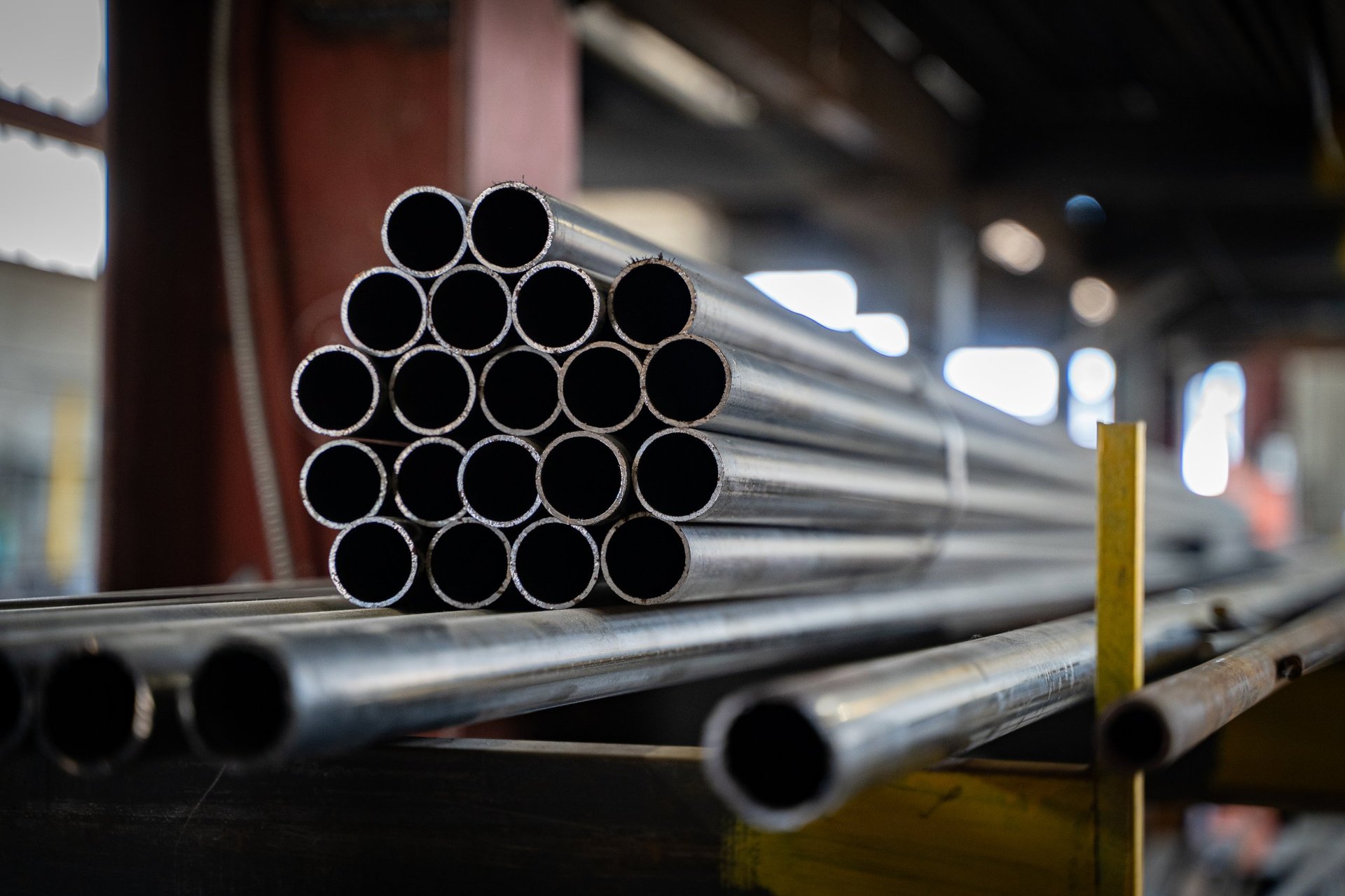
The mass basis is nominal; grade, wall tolerance, coating mass and the actual shipment mass remain separate gates confirmed against the standard and the weigh report.
Related references
Pair the weight basis with the reference you use
Steel Pipe Dimensions Chart
Confirm the NPS/OD and schedule that feed the weight basis before converting length to mass — dimensions inform the wall and the weight.
Open referenceSteel Pipe Schedule Chart
Confirm the wall series and its limits so the weight estimate is built on a verified wall rather than a guessed one.
Open referenceMarkets
Steel pipe weight across the GCC
Noor Deira Steel coordinates steel pipe supply, documentation and delivery for buyers across the GCC, on a verified nominal mass basis.

United Arab Emirates
Carry the verified NPS/OD, wall/schedule, total mass estimate and destination into the RFQ so the commercial team can confirm the dimensional basis, quantity and document set for delivery to site or stockist.
Steel pipe supplier
Saudi Arabia
State the dimensional standard/edition, NPS/OD, wall, length-based mass estimate, quantity and delivery base so the quotation matches the requirement and documents stay aligned.
Steel pipe supplier
Qatar
Confirm standard/edition, NPS/OD, wall, mass basis, quantity and delivery window so the estimate and logistics stay aligned to the order.
Steel pipe supplier
Kuwait
Provide destination and Incoterm so the document and delivery plan can align with the verified mass basis.
Steel pipe supplier
Bahrain
Confirm contract terms, standard/edition, NPS/OD, wall and delivery base before quotation.
Steel pipe supplier
Oman
Provide destination, required documents and delivery date so the quotation can be fixed on the verified mass basis.
Steel pipe supplierExpert insight
Which nominal bare-pipe weight basis to carry into the RFQ
A nominal bare-pipe mass, clearly scoped
Once the correct dimensional row is verified, the nominal bare-pipe weight basis is computed from the outside diameter and wall under a stated standard, at a disclosed density. ASME B36.10 — Welded and Seamless Wrought Steel Pipe — standardizes dimensions for welded and seamless wrought steel pipe for high- or low-temperature and pressure service; it identifies the OD that feeds the mass. Reference reviewed 2026-09-04; the ASME page identifies B36.10-2022.
A dimensional standard does not by itself establish material grade, project design pressure, corrosion allowance, or fitness for a specific service.
ASME B36.10 — Welded and Seamless Wrought Steel Pipe reference
Buyer implication — verify in the RFQ
The buyer can use the nominal weight for dimensional or quantity preparation only after the standard/edition row and the wall are verified. Material and design-code checks remain separate gates before service acceptance: wall tolerance, grade/PSL type, pressure rating and coating mass are each confirmed against the governing standard, the design code and the mill/weigh certificate.
Carry the verified NPS, OD, wall, mass basis and length/count into the RFQ, and state the quantity, destination, Incoterm and delivery date so the quotation is built on an auditable nominal mass basis rather than a guessed value.
Why this approach
A nominal mass basis that cannot quietly drift
Treating a weight figure as a firm shipment invoice line
The estimator labels every result nominal and separates the computed mass from coating, tolerance, packaging and the actual shipment weigh ticket.
A defensible quantity envelope for logistics planning, with the invoiced mass still reconciled to the mill weigh report.
Assuming a single fixed weight for an NPS regardless of wall or schedule
The estimator combines the standard nominal OD with a user-supplied wall so the weight follows the actual wall, not a rounded size.
A nominal mass that tracks the real wall/schedule and therefore answers which schedule is meant before you convert length to tonnes.
Mixing unit systems and producing false precision
OD, wall and length are kept in one stated unit system, and kg/m, kg/ft and lb/ft conversions are labelled rather than blended.
A coherent estimate that another engineer or buyer can re-run and audit against the named method and assumption.
Using a partial chart weight without an authority or verified OD/wall
Only the nominal OD subset referenced to ASME B36.10 is carried; unsupported sizes and invalid OD/wall pairs force a verify-against-standard path rather than a guessed number.
A copyable estimate line that names source, edition, density and unit basis for an auditable RFQ.
Hiding length, quantity and destination inside a vague request
The commercial section turns standard/edition, NPS/OD, wall, length-based mass, quantity, destination and Incoterm into an explicit RFQ.
A logistics-explicit quotation built on a verified nominal mass basis rather than a guess.
Order path
From mass enquiry to closed-out delivery
- 1
Requirement
Input · NPS or OD, wall/schedule, standard, unit system.
Outcome: Dimensional basis stated; size identified.
- 2
Mass basis
Input · Nominal OD and wall under the stated standard.
Outcome: Nominal unit mass computed on the disclosed basis.
- 3
Quantity estimate
Input · Length per piece and piece count.
Outcome: Estimated piece and total bare-pipe mass.
- 4
Quotation
Input · Quantity, Incoterm, destination, date.
Outcome: Availability and pricing on request.
- 5
Inspection & weighing
Input · Dimensional, tolerance, test and weigh checks.
Outcome: OD, wall, length and mass reconciled to the mill ticket.
- 6
Packing
Input · Bundling, tagging, lashing.
Outcome: Bundled and tagged by size, schedule, material and lot.
- 7
Shipping
Input · Incoterm, port, documents.
Outcome: Coordinated to destination.
- 8
Delivery & follow-up
Input · Site handover, closed-out docs.
Outcome: Handed to site with documents.
FAQ
Steel pipe weight — the questions buyers ask
Which standard controls the values shown in this Steel Pipe Weight Chart resource?
The page derives nominal bare-pipe mass from the outside diameter and wall under a stated dimensional standard — referenced to ASME B36.10 — Welded and Seamless Wrought Steel Pipe — and requires you to name the governing standard and edition before any value is shown. The chart identifies its source and the density assumption, and never implies a dimension or mass is authoritative on its own; the edition and any project-specified standard are confirmed at quotation.
Why can the same NPS have different wall thicknesses or weights?
NPS fixes the nominal outside diameter, but the wall — and therefore the weight — changes with the schedule. Two pipes of the same NPS and different schedule share one OD yet differ in wall, cross-section and unit mass. This is why the estimator takes the OD and requires a wall rather than assuming a single fixed weight for a size.
Does schedule by itself determine pressure rating?
No. Schedule is a nominal wall series in the dimensional standard; it does not by itself establish pressure capability. Design pressure is judged by the governing design code and the wall calculation, not by a schedule name. The estimator states this boundary explicitly and hands wall and pressure decisions to the design engineer and code.
How should metric and inch-pound values be handled in an RFQ?
Keep the unit system coherent and state it in the RFQ. The page computes with OD and wall in one stated system and labels kg/m, kg/ft and lb/ft conversions so there is no false precision. Never mix a millimetre wall with an inch OD, or a metres length with a per-foot basis, without stating both.
Which result should be copied into the RFQ and which values still require engineering verification?
Copy the verified estimate line — NPS, OD, wall/schedule, nominal unit and total bare-pipe mass, the density assumption and the standard/edition-to-be-confirmed — into the RFQ. Material, grade/PSL type, wall tolerance, pressure rating, coating mass and the actual shipment mass are separate: they are confirmed against the governing standard, the design code and the mill/weigh certificate, and are never read off a weight chart alone.
Request a quote
Send the verified steel-pipe specification for RFQ
Need a verified steel pipes specification? Send grade, size, quantity and destination for technical RFQ support. Price remains on request; the nominal mass basis, availability, documents and lead time are confirmed from the full, verified specification.
What to send
The more fields you complete in the Weight Estimator, the faster the commercial team can confirm availability, documents and lead time. Paste the copied mass basis straight into the message, or use the form fields below — and keep the wall, grade and service suitability checks separate.
Response & documents
Response times, certificate sets and lead time are confirmed per project. No stock, origin or price figure is published; the nominal mass basis is confirmed against the mill/weigh report at order.
Formula & method
How a nominal mass result is built
Annular cross-section
Unit bare mass = annular area × stated density, from the nominal OD and the wall. The value is computed on the disclosed method and density — it is an estimating basis, not a shipment weighing.
Unit coherence
OD, wall and length share one stated unit system, and kg/m, kg/ft and lb/ft conversions are labelled. No cross-unit mixing that creates false precision.
What is never computed
Pressure rating, wall from schedule, coating mass, actual shipment mass, grade/PSL type and service suitability are not derived here. They are confirmed against the governing design code, the standard, the mill certificate and the weigh report.
More worked examples
Decision impact of a verified nominal mass basis
Metric quantity estimate
Input: NPS 6, wall 5.5 mm, 12 m × 40 pcs, metric, ASME B36.10.
Method: OD 168.3 mm, annular cross-section with a 5.5 mm wall at 7850 kg/m³ gives ≈ 22.1 kg/m nominal.
Action: 12 m × 40 pcs ≈ 10.6 t nominal bare-pipe mass for freight and handling; the wall is confirmed from the mill certificate before converting length to tonnes for the order.
Coating and packaging boundary
Input: The same 10.6 t nominal bare-pipe mass.
Method: A coating or packaging adds mass that is not in the bare estimate; tolerance moves the wall within a small band.
Action: Keep the estimate nominal and request coating/gross mass and the weigh report for the actual shipment; never assume the computed mass is the invoiced weight.
Reference
Downloadable and printable reference
Print the reference table
The nominal-OD table and the worked-example table on this page are the printable subset. Confirm the full size range, the wall and the edition against the printed ASME B36.10 before ordering.
Primary source
ASME B36.10 is the governing dimensional reference (reviewed 2026-09-04; B36.10-2022). Verify the edition at quotation.
Documents
Request the mill test certificate and the dimensional and weigh report with every consignment so OD, wall, length and mass are traceable to the shipped heat.