
Grades & Standards Reference
Carbon Steel Grades
Carbon grades differ by carbon content — low, medium and high — which sets their strength and weldability under designations like A36, S275 and AISI 1018; use the mapper below to narrow to the one that fits before you commit to a spec.
Information date:
Definition & boundaries
What counts as a carbon steel grade here — and what does not
On this page a carbon steel grade is a steel whose main alloying addition is carbon, identified by designations like A36, S275 or AISI 1018. Stainless and alloy grades are routed elsewhere, not blurred in.
In scope
Structural grades (A36, S275), machining grades (AISI 1018, 1045) and low-carbon sheet grades (DC01, DC04), each with its governing standard and carbon class.
Out of scope
Stainless steel grades and alloy steel grades are not covered here. They belong to their own routes, not to this carbon comparison.
How it is bounded
A grade is fixed by its designation and standard together, so a carbon-content difference — 1018 versus 1045 — is never collapsed into one bucket.
Product Mapper
State the application, strength need and weldability — get the grade
Three inputs return the matching carbon grade(s) with their real composition and standard reference. No generic fallback.
Not sure of the carbon content or grade? Send it for review.
Request Quote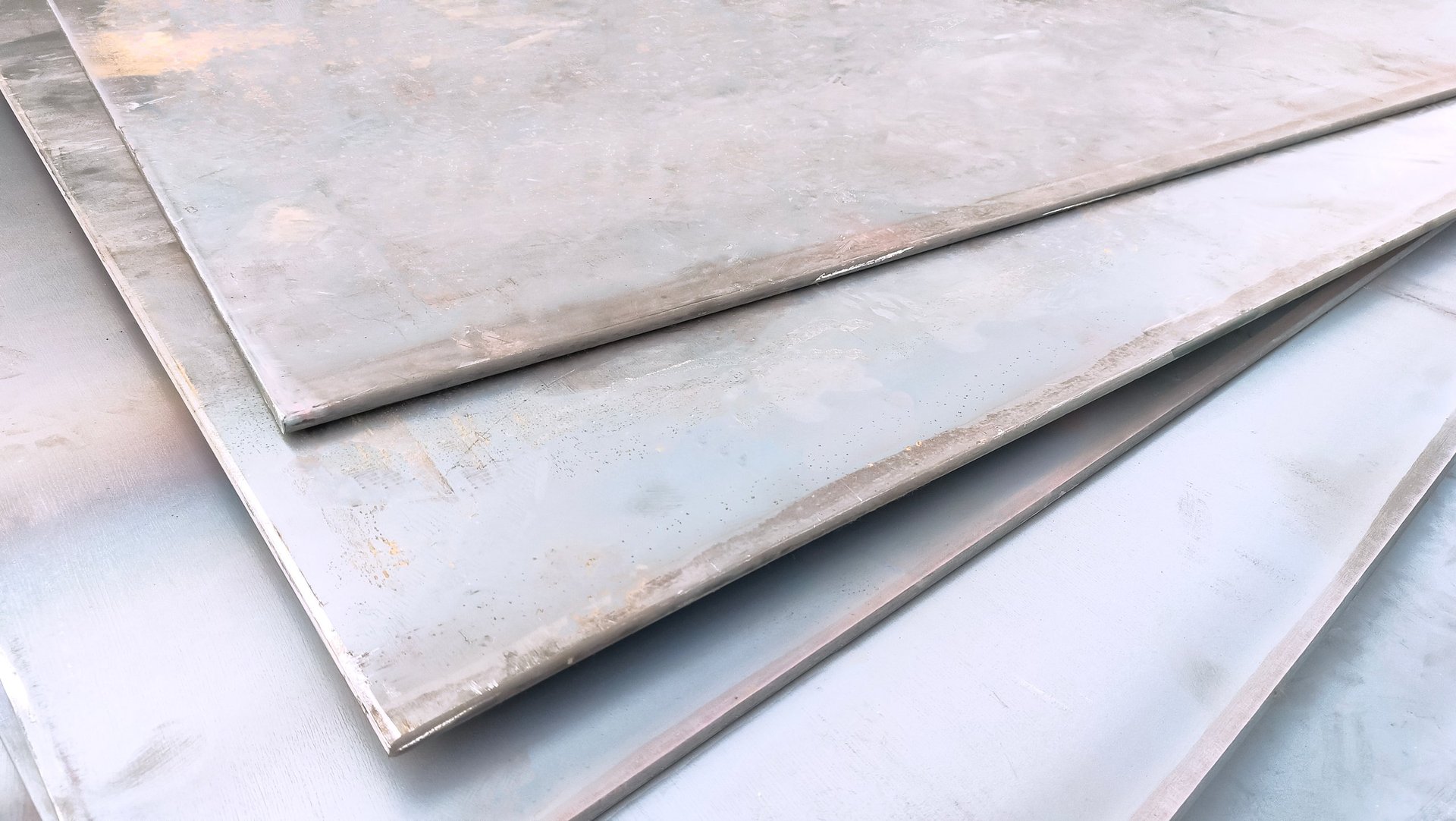
Carbon steel plate — the grade and its carbon content drive how it is cut and welded.
The full carbon range
The mapper covers the grades listed in the definition above. The grade designations with their standards and carbon class sit just below.
| Designation | Standard | Carbon class | Typical use |
|---|---|---|---|
| A36 | ASTM A36 | Low-carbon | Structural shapes, plates, fabricated sections |
| S275 | EN 10025 | Low-carbon | General construction and fabrication |
| AISI 1018 | AISI / SAE | Low-carbon | Shafts, pins, light machined components |
| AISI 1045 | AISI / SAE | Medium-carbon | Shafts, gears and load-bearing parts |
| DC01 | EN 10130 | Low-carbon | Cold-rolled sheet, general forming |
| DC04 | EN 10130 | Low-carbon | Deep-drawing sheet, more demanding forming |
Cross-product mapping
If carbon is not the fit, jump to a sibling family
A comparison table that routes you to the neighbouring grade family rather than a dead end.
| Grade family | What it covers |
|---|---|
| ASTM Steel Grades | American material designations across the range. |
| EN Steel Grades | European EN material numbers by standard. |
| API Steel Grades | Line-pipe and oilfield grades. |
| Stainless Steel Grades | The corrosion-resistant companion grades. |
| Steel Specifications | How a specification is written and verified. |
| Knowledge Center Hub | Background reading, size charts and comparisons. |
Selection criteria
The four factors to weigh before you fix a carbon grade
Strength, weldability, machinability and cost are the levers. Each pulls the choice toward a different carbon content.
Strength
Higher strength pushes toward a medium-carbon grade like 1045 — at the cost of weldability.
Weldability
Heavy welding favours the low-carbon grades (A36, S275, 1018) that take a clean weld.
Machinability
Parts machined from bar stock lean to a low or medium-carbon grade suited to cutting.
Cost
Carbon steel is the lower-cost baseline versus stainless; grade and form still move the price.
Applications & limits
Where carbon steel is the right choice — and where it is not
Carbon steel earns its place where structure and machinability matter and corrosion resistance is handled another way. It is honest about its limits too.
Right choice when
- Structural shapes, plates and fabricated sections.
- Machined shafts, pins and general components.
- A formable, lower-cost baseline versus stainless.
Not the right choice when
- Corrosion resistance is non-negotiable — a stainless grade is required.
- High hardness without heat treatment limits the achievable strength.
- A high-carbon grade would need to be welded, where it is crack-prone.
Constraints to confirm
- Whether the part needs heat treatment after forming.
- Size and bar-stock availability for the exact grade.
- The carbon content versus the weld approach on site.
Evidence-based advantages
Buyer concern → provable capability → outcome
Four cards; each rests on a verifiable control, not a statistic.
Grade delivered is not the grade ordered
Each carbon grade is tied to its designation (A36, S275, 1018 …) and verified against its governing standard before release.
A 1045 order cannot be swapped for 1018 without the certificate showing it.
Carbon content guessed for a welded joint
The mapper asks weldability first, so a heavy-welding job is steered to the low-carbon grades that take a weld cleanly.
A weld-critical detail is not routed to a high-carbon, crack-prone grade.
Strength needed but heat treatment overlooked
Load-bearing needs surface the medium-carbon 1045, with the treatment requirement flagged rather than hidden.
The strength requirement is carried by the grade built for it, not a formable baseline.
Size and bar-stock availability
Grade, dimensions and standard are reconciled together — size requirements are part of the check.
The enquiry is quotable in one pass rather than reopened for a missing size.
Expert insight
The strength-versus-weldability trade-off
The one factor that most often decides a carbon grade is how much carbon the job can tolerate before the weld becomes the problem.
Carbon content is strength and weldability at once
The same carbon that raises a grade's strength is what makes it harder to weld. A medium-carbon 1045 is stronger than a 1018 after treatment, but it is far less forgiving under the welding torch. Specifying from that trade-off — how strong, and how welded — is what prevents a high-strength part from cracking at the joint.
Ask “how much welding?” alongside “how strong?”
— they pull in opposite directions.

Structural carbon steel — A36 and S275 carry the frame when low-carbon weldability is required.
Method & source
This guideline is a reading of the carbon-equivalent and weldability guidance published by the World Steel Association (worldsteel), which describes how increased carbon content raises strength while reducing weldability and formability. The method is a reading of that guidance, not a reproduction of it.
From enquiry to delivery
Ten steps after you have picked your grade
Written for a visitor who has just identified their carbon grade and is ready to take it through the order.
- 01
Requirement or need
Buyer- Input
- Application, strength, weldability need
- Verification risk
- Unstated strength class
- Output
- A carbon grade requirement in plain terms
Next: Send to specification intake
- 02
Specification intake
Commercial team- Input
- Grade, standard, dimensions
- Verification risk
- Grade stated without its standard
- Output
- Requirement captured against a standard
Next: Hand to technical review
- 03
Technical review
Technical review- Input
- Grade and standard cross-check
- Verification risk
- Carbon content versus weld need
- Output
- Confirmed grade and standard
Next: Move to quotation
- 04
Quotation
Commercial team- Input
- Scope and terms
- Verification risk
- Unfixed quantity or treatment
- Output
- Price on request and terms
Next: Await confirmation
- 05
Order or contract
Buyer + commercial- Input
- Confirmed order and documents
- Verification risk
- Undocumented verbal change
- Output
- Order and document list
Next: Trigger quality checks
- 06
Quality and document checks
Warehouse / QA- Input
- Certificate and material conformity
- Verification risk
- Certificate not tied to heat
- Output
- Conformity confirmed
Next: Pack order
- 07
Packing
Warehouse- Input
- Pick list and packing method
- Verification risk
- Surface damage in transit
- Output
- Bundled, protected, edge-guarded
Next: Ship
- 08
Shipping
Logistics- Input
- Document pack and route
- Verification risk
- Incomplete document pack
- Output
- Load released with documents
Next: DeliverMarkets Hub
- 09
Delivery
Logistics- Input
- Destination and access
- Verification risk
- Unconfirmed site access
- Output
- Delivery note countersigned
Next: Close outMarkets Hub
- 10
After-sales
Commercial team- Input
- Discrepancy record
- Verification risk
- Late-reported discrepancy
- Output
- Resolution with carrier and buyer
Next: Resolve any open item
FAQ
Carbon grade selection, answered directly
What is the difference between low and high carbon steel?
It is the carbon content. Low-carbon is soft, formable and weldable; medium-carbon balances strength and ductility; high-carbon is hard and strong but harder to weld and form.
Which carbon grade should I use for structural work?
A36 or S275 are the common structural grades — S275 carries a 275 N/mm² minimum yield. Both are low-carbon and weldable for general construction and fabrication.
What does AISI 1018 or 1045 mean?
The last two digits are the carbon content in hundredths of a percent. 1045 is roughly 0.45% carbon and is stronger than 1018 (about 0.18%) after treatment.
Can carbon steel be heat treated?
Medium-carbon grades like 1045 respond to heat treatment for higher strength. The exact treatment depends on the part and is confirmed at specification, not assumed.
How much cheaper is carbon steel than stainless?
Carbon steel costs less than stainless because it lacks the chromium and nickel content. The exact figure is on request and depends on grade, form and quantity.
What carbon grade suits cold-formed sheet and panels?
DC01 for general forming, or DC04 for more demanding deep drawing — both are low-carbon cold-rolled sheet grades under EN 10130.
How do I confirm the exact carbon grade and standard?
State the grade and its governing standard (A36, S275, 1018 …), then send it for review. The technical team cross-checks the carbon content against the application before release.
Request a Quote
Name the carbon grade, standard, dimensions, quantity and destination, and the commercial team reconciles it against the governing standard.
Serving GCC buyers and export destinations