
ASTM A615 Grade 75 Rebar
ASTM A615 Grade 75 Rebar
ASTM A615 Grade 75 is a specified high-strength designation, not a strength upgrade you apply on site. ASTM A615/A615M-26 carries Grade 75 [520] as a 75,000 psi [520 MPa] minimum-yield grade available in the larger bar sizes only — so before you design to it, confirm the edition your project is bound to, whether your bar size is even permitted at Grade 75, and the ductility, anchorage and inspection requirements your design code imposes. It is not a substitute for an A706 grade, and it is not interchangeable with a generic Grade 80 label.
Before this grade is ordered
- The governing A615/A615M edition is an acceptance field, not a default.
- Grade 75 is specified for particular bar sizes — the size must be permitted.
- Ductility, anchorage and inspection come from your design code, separately.
Information current as of
When Grade 75 Fits & What To Compare
Selecting a high-strength grade is a design decision, not a strength label
Grade 75 is the right answer only when the structural design calls for a 75,000 psi [520 MPa] minimum-yield A615 designation and your bar size is permitted at that grade. Every alternative below is a bounded comparison, and none of them is interchangeable with your specified grade unless the design is revised.
ASTM A615 Grade 75 rebar
Current gradeWhen it fits
When the design genuinely calls for a 75,000 psi [520 MPa] minimum-yield A615 designation and your bar size is permitted at that grade in the governing edition.
Boundary
Requires the specified edition, a permitted bar size, the ordered unit system, the design-code ductility/anchorage provisions and per-lot tensile evidence. Never selected by strength alone.
ASTM A615 Grade 60 rebar
Lower grade in the same standardWhen it fits
When the design only requires the 60,000 psi [420 MPa] designation — the more common A615 grade with a wider permitted size set.
Boundary
Moving between Grade 60 and Grade 75 is a design change. Do not down-grade or up-grade without the structural designer confirming the revision.
Compare specificationASTM A706 rebar
Different specificationWhen it fits
When the project governs low-alloy steel bar to A706 — often where controlled chemistry, ductility or weldability provisions are written into the design.
Boundary
A706 is a separate specification: its own grades, chemistry limits and mechanical framework. It is not an A615 Grade 75 under another name.
ASTM steel grades
Cross-product taxonomyWhen it fits
Orient the Grade 75 decision inside the wider ASTM grade reference before comparing designations across product families.
Boundary
The reference is orientation, not acceptance. The governing edition and grade still decide what may be supplied.
Compare specificationSelection rule
Do not select Grade 75 because it is stronger. Select it because the design specifies it, in a bar size the governing edition permits at that grade, with the ductility and anchorage provisions applied by your design code. A change from Grade 60 to Grade 75 — or from Grade 75 to anything else — is a design revision, and the comparisons above are decision aids, never automatic equivalence.
High-Strength Acceptance Matrix + RFQ Builder
Validate the edition, grade, permitted size and bar form — then build the enquiry
Enter what your specification actually states. The matrix refuses a non-A615 edition, flags a Grade 80 label as a conflict, holds the result at 'verify first' when the permitted size is missing, and lists the design-code questions your engineer still has to close.
Specification inputs
Required fields marked *Use the edition the project or purchase specification requires.
Grade 75 is permitted only in certain bar sizes — confirm against the edition.
Commit to one ordered system per lot; label any conversion informational.
Required test / document evidence
Nominal mass refers to the base bar and is either supplied by you or confirmed against the governing standard and the supplied MTC. This matrix does not estimate weight, does not certify a bar size, and never treats the grade name as tensile evidence.
Acceptance check
Add the governing edition next
The grade is set; the edition decides the permitted size set and the test framework that applies. State the edition — for example ASTM A615/A615M-26, or the earlier edition the project names.
Still open on the design side
- Ductility & elongation class the design code assigns to the specified grade.
- Anchorage, lap and development-length provisions for that grade.
- Whether your bar size is permitted at Grade 75 in the governing edition.
- Inspection/testing hold points the project imposes on the supplied lot.
Grade-boundary checks
- Grade 75 is a specification decision made with the structural designer — never a site substitution, and never inferred from a higher strength label.
- ASTM A706 is a different specification with its own ductility and chemistry framework; an A706 grade is not an A615 Grade 75 equivalent without explicit engineer approval.
- A generic Grade 80 label is not the same as A615 Grade 75 [520] — different standard, different grade designation, different size-permitted set.
- Inch-pound (Grade 75) and SI (Grade 75 [520]) identify the same requirement in different systems and must not be mixed as separate acceptance values within one lot.
- The grade name does not prove weldability or a specific bar form — welding and coated/prebent forms are separate specification fields.
Nothing is transmitted yet, and this matrix does not approve a substitution. When the specification is complete, send the summary to the commercial department for a confirmed quotation.
Standard, Grade, Bar Form & Tensile Evidence
Decision-grade reference for a Grade 75 specification
Four fields decide whether a Grade 75 enquiry is defensible: the edition you are bound to, whether your bar size is permitted at that grade, the design-code ductility and anchorage provisions, and the bar form you actually need. Values below require authoritative evidence with stated units and conditions — no unsupported numbers are published on this page.
Grade & governing standard
Which specification and designation actually govern the bar
| Standard / grade | Applicability & limitation | Implication for the buyer | Enquiry field / next action |
|---|---|---|---|
| ASTM A615/A615M Grade 75 [520] | A 75,000 psi [520 MPa] minimum-yield carbon-steel reinforcing-bar designation carried by the A615/A615M framework, specified for particular bar sizes. | Confirm the edition and that your bar size is permitted at Grade 75 before the design is detailed around it. | State edition, grade and size. |
| ASTM A615/A615M Grade 60 [420] | The 60,000 psi [420 MPa] designation in the same framework, with a wider permitted size set. | Moving between Grade 60 and Grade 75 changes ductility, anchorage and detailing — treat it as a design revision, not a purchasing swap. | Confirm designer approval before changing grade. |
| ASTM A706 / A706M | A separate low-alloy specification with its own grades, chemistry limits and mechanical framework. | An A706 designation is not an A615 Grade 75 equivalent. Where the design governs A706, the enquiry is governed by A706. | State the governing specification explicitly. |
| Generic Grade 80 labelling | A strength label used across different standards and product families; it does not identify an A615 grade designation. | Do not accept a Grade 80 label as satisfying an A615 Grade 75 requirement — resolve which designation the project specifies. | Resolve the designation before quoting. |
The table states standard scope from public standard information. Confirm the exact edition, its permitted size set and its requirements against the current standard documents before specifying — no unsupported numeric values are published here.
Bounded comparison
The related routes that answer the next question
Each route below is a bounded reference for a specific adjacent decision — the grade one step down, the standard this grade sits inside, and the grade ladder itself. None of them is interchangeable with your requirement unless the design authority approves the change.
ASTM A615 Grade 60
Open referenceASTM A615 rebar
Open referenceThe rebar grade ladder
Open referenceASTM steel grades
Open referenceComparison is bounded to the stated standard, grade and size basis. Do not substitute a grade, diameter or standard without an approved design change.
Bar form & fabrication
The form you order carries its own requirements beyond the grade
| Form / decision | Applicability & limitation | Implication for the buyer | Enquiry field / status |
|---|---|---|---|
| Plain or deformed form | The deformation pattern and surface condition the governing standard permits for the designation. | State the required form; the grade designation alone does not fix the surface condition the bar must carry. | State bar form. |
| Bending & cutting | Bend and rebend acceptance, minimum bend diameter and fabrication tolerances are defined by the governing standard and the project detailing. | Confirm minimum bend diameter and scheduling against the detailing, especially where bar spacing is tight. | Confirm bend requirement & schedule. |
| Welding & mechanical splicing | Welding and splicing are governed by their own procedures and details — not implied by the grade name. | If welding or splicing is central to the design, state it on the enquiry and require the applicable procedure and material information. | State welding/splicing requirement. |
| Coating & surface protection | Coated forms carry their own handling, storage and inspection requirements on top of the grade. | Select a coated form only where the durability specification requires it, and confirm the coating standard separately. | State coating requirement. |
Bar form, bend, coating and fabrication requirements are carried as separate enquiry fields. The grade designation is never treated as evidence for any of them.
Strength, ductility & tensile evidence
Which measured properties your acceptance actually rests on
| Property | Applicability & limitation | Implication for the buyer | Enquiry field / status |
|---|---|---|---|
| Yield strength | The designation states a minimum-yield requirement; the measured value belongs to the tested heat in the ordered unit system. | Confirm the edition and grade, then read the actual yield from the MTC — never from the designation alone. | Confirm edition + request tensile results. |
| Tensile strength | Measured together with yield on the tension test defined by the governing standard. | Request tensile results tied to the supplied heat; a tensile ratio is a test outcome, not a nominal figure to assume. | Request tensile results. |
| Elongation & ductility | Measured on the specified specimen in the ordered unit system, and separately constrained by your structural design code. | Confirm the elongation class and the design-code ductility provision both clear, since they are two distinct checks. | Confirm design-code ductility provision. |
| Bend / rebend acceptance | An acceptance test applied to the lot per the governing standard, with a minimum bend diameter for the size and grade. | Confirm bend/rebend results on the actual lot and that the detailing bend diameters satisfy the minimum. | Request bend results + confirm detailing. |
| Chemistry | Checked against the MTC and standard where grade identity, welding or fabrication requires it. | Where welding is specified, require the applicable procedure and material information — chemistry alone does not establish suitability. | State welding procedure + MTC review. |
Chemical and mechanical values are governed by the standard and verified on the mill test certificate for the delivered heat. They are not published as fixed numbers here, because the applicable edition, grade and bar size must be known first.
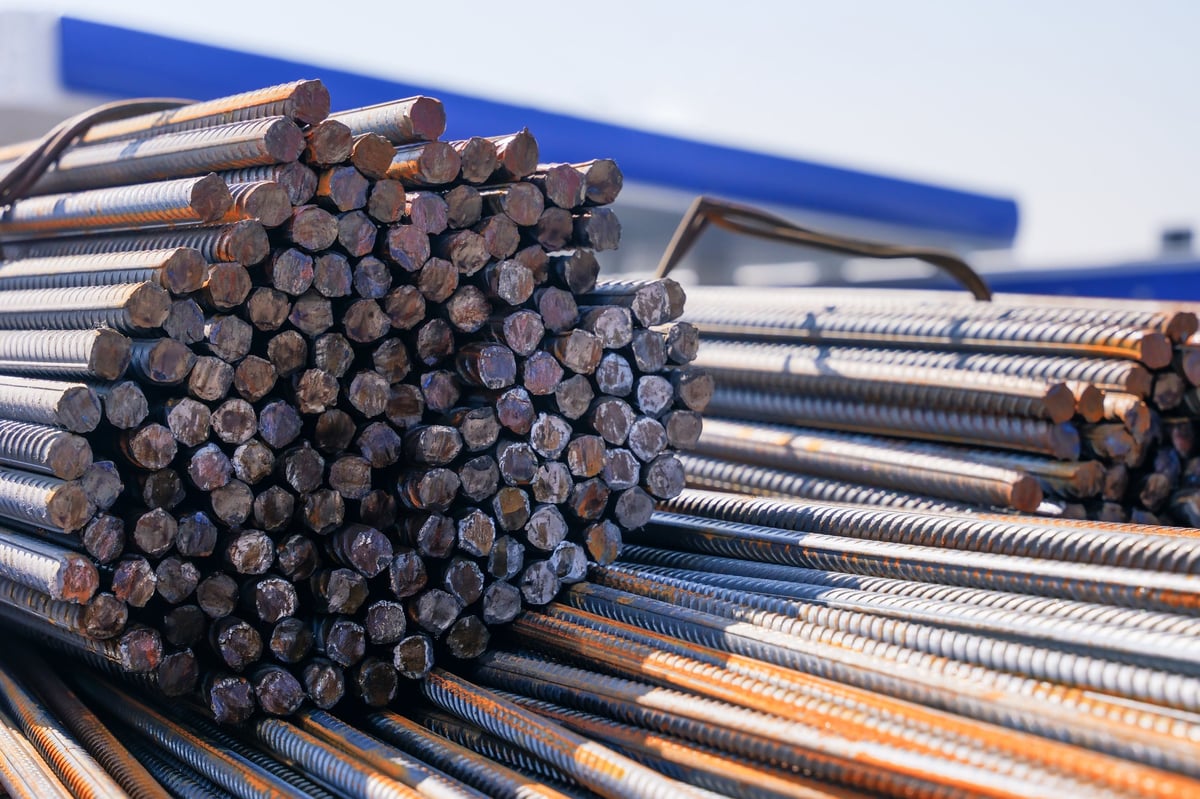
Identification & marking
Verify the identification before acceptance, not after delivery to site
Grade and size identification, bar marking and bundle traceability are what connect a delivered consignment back to its heat and its test records. Check that the marking and tags correspond to the governing edition and the grade your design specifies — an identification mismatch is easier to resolve at the inspection gate than as a fixing in a congested detail. The imagery here illustrates the verification step; it is not a representation of a specific delivered bundle.
Testing, Documentation & Evidence
What is standard, what is lot-specific, and when each record is needed
A high-strength grade makes the evidence question sharper, not softer: the designation states a minimum, and the mill test certificate states what the delivered heat actually achieved. Keep the two apart and state what you require up front.
| Evidence / document | What it verifies | When it is required | Enquiry action |
|---|---|---|---|
| Mill Test Certificate (MTC / EN 10204 3.1) | Identity, chemistry and mechanical results for the heat that produced the bar lot. | Where the project requires certified material, and for any high-strength grade where acceptance rests on measured results. | Request at enquiry; content confirmed against the delivered lot. |
| Tensile & yield results | The measured yield and tensile performance of the supplied heat against the grade requirement. | When the project or the design code requires tensile evidence rather than grade identification alone. | Request results tied to the heat. |
| Bend / rebend results | Bend acceptance of the lot, including the minimum bend diameter appropriate to the size and grade. | Where the project requires bend testing or the detailing approaches the minimum bend diameter. | Request results tied to the heat. |
| Chemistry & marking verification | Grade identity, relevant chemistry fields and the bar marking that ties a bundle to its heat. | When welding, grade identity or fabrication depends on chemistry, or where marking traceability is an inspection item. | Verify against MTC and the standard. |
| Bundle weight, size & traceability tags | Bundle weight, bar size/designation and the tags that connect a bundle to its records. | For schedule control, dimensional checks and site traceability. | Confirm marking and traceability requirements. |
| Design-code compliance record | The ductility, anchorage and development provisions your structural design applied to this grade. | Where the design code imposes provisions beyond the material standard, or an authority requires the design check on file. | Provide from the designer; not a supplier document. |
Standard vs supplied lot
The standard defines the requirement; the MTC evidences the delivered heat. Both are needed, and neither replaces the other.
Issued on test
Certificates and test records are issued against the actual delivered lot — they cannot be asserted in advance of it.
Design-side record
Ductility, anchorage and development checks sit with your structural designer, not with the supplier's documentation.
Rebar chemical & mechanical properties
Check how yield, tensile, elongation and chemistry requirements are framed for a specified grade, and what your MTC must evidence.
Open technical referenceRebar bend diameter guide
Resolve the minimum bend diameter and detailing implications before a high-strength bar is scheduled for fabrication.
Open technical referenceApplication Decision Paths
Where a high-strength grade changes the engineering, not just the bar schedule
The applications below are the ones where specifying Grade 75 interacts with something other than strength — ductility under precast handling, crack width in chloride exposure, or detailing capacity in a congested lining. Each states the fit limit that still has to be confirmed.

Precast concrete rebar
Engineering driver
Precast adds controlled casting, form-release timing and lifting stresses — all of which shift the ductility and anchorage checks your design must clear at a high-strength grade.
Fit limit
Confirm the application context genuinely matches before the grade is fixed; precast handling requirements act on top of the grade, not instead of it.
Open applicationMarine structure rebar
Engineering driver
Chloride exposure governs cover, crack-width control and coating strategy — and higher-strength bars change the crack-width relationship in the design.
Fit limit
The exposure class is confirmed against the project durability specification; the grade decision never substitutes for it.
Open applicationTunnel rebar
Engineering driver
Tunnel linings combine tight bar spacing, heavy congestion and demanding fixing tolerances, which act directly on bend, anchorage and detailing decisions at Grade 75.
Fit limit
Detailing capacity at the congested section is confirmed by the designer; this page does not certify a bar for a given tunnel layout.
Open applicationApplication fit is confirmed against the governing specification, the bar size permitted at the grade and the design code at the time the enquiry is quoted. No generic or unsupported use claims are made on this page.
GCC Markets & Destination Planning
Plan the destination, documents and delivery basis for a Grade 75 order
For each GCC destination the specification, documents and commercial terms are aligned to your project basis at quotation. Availability and delivery are confirmed from your complete specification — never claimed in advance.

United Arab Emirates
Technical submittal and document review.
Add the delivery location, importer/customs inputs, Incoterm and document set before the Grade 75 rebar RFQ is issued.

Saudi Arabia
Large EPC quantities and cross-border documentation.
Confirm the delivery location, importer inputs, Incoterm and documents so the high-strength grade is quoted on one consistent basis.

Qatar
Infrastructure technical-approval readiness.
Add the technical submittal and document package the project requires for a specified high-strength grade.

Kuwait
Contractor and fabricator hand-off.
State the delivery location, Incoterm, documents and required date so the order can be planned against the grade basis.

Bahrain
Contractor procurement and industrial supply.
Provide destination, importer/customs inputs, Incoterm and documents before quotation of the Grade 75 rebar.

Oman
Port-oriented project supply planning.
Confirm the destination, required documents and Incoterm so the quotation basis is fixed for the specified grade.
Destination, documents, port or delivery line, Incoterm and the required delivery date are fixed at quotation from your specification. No served markets, local stock, local branches or delivery times are claimed in advance.
Commercial & Availability Inputs
The inputs that turn a Grade 75 specification into a confirmed offer
Availability, packaging, documents, Incoterm and delivery are agreed from your full specification. Price is always on request — no live stock, lead-time or pricing claims are made before quotation.
| Quotation input | What it fixes | Status |
|---|---|---|
| Governing edition & grade | Which A615/A615M edition and which grade designation the offer is made against. | Required before quotation. |
| Bar size & permitted-size check | The nominal size and confirmation that it is permitted at Grade 75. | Required before quotation. |
| Quantity & unit | Total tonnes or bar count for the schedule. | Required for quotation. |
| Bar form & fabrication | Plain, coated, cut-and-bent or spliced form, and any welding requirement. | Required for scheduling and pricing. |
| Packing & bundle marking | Bundled, strapped and tagged with size, grade and heat marking. | Confirmed from the order. |
| Inspection & documents | The MTC plus any tensile, bend, chemistry and marking records required. | Fixed at quotation per the standard and service. |
| Availability (stock / mill) | Whether the enquiry is met from current availability or scheduled production. | Confirmed at quotation — never claimed in advance. |
| Incoterm & named place/port | The commercial and delivery basis for the consignment. | Fixed with the destination. |
| Required date | The delivery window the programme depends on. | Confirmed against availability. |
Price, stock, lead time, mill/origin and routing are quotation-dependent unless current verified evidence is present.
Commercial department
The commercial desk checks each Grade 75 enquiry for edition and grade consistency, confirmation that the bar size is permitted at that grade, bar-form and fabrication clarity, the required document set and the delivery basis before quoting. Continue to the exporter route when packing, named place, Incoterm, export-document and shipment-planning fields are needed.
Steel rebar exporterOffice 3303, Churchill Executive Tower, Business Bay, Dubai, United Arab Emirates
Monday – Saturday: 8.00 AM – 6.00 PM · Sunday: Closed
Evidence-Led Buyer Outcomes
What each concern is checked against, and what you can rely on
Each risk on this page is mapped to the check that actually addresses it, then to a practical procurement outcome. No superiority claims and no unverifiable product claims are made.
| Buyer concern | Check on this page | Outcome you can rely on |
|---|---|---|
| Treating A706 or a generic Grade 80 label as a Grade 75 equivalent | The acceptance matrix rejects a non-A615 edition outright and flags a Grade 80 label as a conflict against an A615 edition. | A mismatched specification is caught before the RFQ, not at the inspection gate. |
| Specifying Grade 75 in a bar size that is not permitted at that grade | The matrix treats the permitted size set as an acceptance field, not a preference, and holds the result at 'verify first' until a size is stated. | Grade-and-size combinations are resolved against the governing edition before a mill order is placed. |
| Leaving ductility and anchorage to the fabricator | The matrix surfaces the ductility, anchorage and inspection questions the design code imposes on the specified grade as explicit flags. | The design inputs are settled by the designer, not discovered during detailing. |
| Accepting a grade name instead of lot tensile evidence | The evidence matrix keeps standard requirements separate from the tensile, bend and chemistry records tied to the supplied heat. | Compliance is demonstrated on the delivered lot, not inferred from the designation. |
| Mixing inch-pound and SI acceptance values in one consignment | The matrix records one ordered system per lot and treats any conversion as informational only. | Acceptance values stay consistent through purchasing and inspection. |
From specification to delivery
- 1
Confirm the grade with the designer
Establish that the design genuinely calls for A615 Grade 75 [520] and not A706 or another standard's high-strength grade.
- Owner:
- Structural designer
- Input:
- Design intent and governing standard
- Output:
- Confirmed grade and standard
- Risk:
- A706 or Grade 80 treated as equivalent
Next: Fix the edition and permitted size
- 2
Fix the edition and permitted bar size
State the A615/A615M edition the project is bound to, and check the bar size against the sizes Grade 75 is permitted in.
- Owner:
- Buyer + designer
- Input:
- Edition, bar size/designation
- Output:
- Permitted grade-and-size basis
- Risk:
- Unpermitted size for the grade
Next: Resolve ductility and anchorage
- 3
Resolve ductility, anchorage and inspection
Confirm the elongation class, development/lap provisions and testing hold points the design code assigns to this grade.
- Owner:
- Structural designer
- Input:
- Design-code provisions
- Output:
- Design-side acceptance basis
- Risk:
- Ductility assumptions left implicit
Next: Set bar form and fabrication
- 4
Set bar form and fabrication requirements
Pin down coating, bending, welding and splicing requirements so the form-specific evidence and handling constraints travel with the enquiry.
- Owner:
- Buyer + fabricator
- Input:
- Form, coating, fabrication note
- Output:
- Form-specific requirements
- Risk:
- Grade name read as proof of weldability
Next: Define the per-lot evidence set
- 5
Define the required lot evidence
State the tensile, bend, chemistry and marking records required against the supplied heat, in the ordered unit system.
- Owner:
- Buyer + inspector
- Input:
- Required documents and tests
- Output:
- Per-lot evidence set
- Risk:
- Grade name substituted for tensile results
Next: Fix destination and commercial terms
- 6
Fix destination, Incoterm and date
Confirm the delivery location, Incoterm rule and required date so the high-strength grade is quoted on a complete commercial basis.
- Owner:
- Buyer + commercial
- Input:
- Destination, Incoterm, date
- Output:
- Commercial and logistics basis
- Risk:
- Unstated port or Incoterm
Next: Issue the qualified RFQ
Technical reference note
Which authoritative requirement most changes a Grade 75 decision
A source-backed note on the requirement that governs this page — stated with its source, its checked date and its limits.
The requirement that changes the decision
ASTM A615/A615M-26 carries Grade 75 [520] as a minimum-yield designation and specifies it for particular bar sizes rather than the full range. Two consequences follow for anyone designing to it. First, the permitted bar size is part of the specification, not a downstream purchasing choice — a Grade 75 requirement detailed in an unpermitted size cannot simply be ordered. Second, the material standard defines the grade designation and its test framework, while the ductility, anchorage, development and inspection provisions applied to that grade in a structure come from the project's structural design code. Those are two separate checks, and passing one does not establish the other.
The same distinction is why an A706 grade or a generic Grade 80 label cannot be read across to A615 Grade 75: each sits inside its own standard, its own grade set and its own size-permitted range.
Primary authority
ASTM International — ASTM A615/A615M-26, Standard Specification for Deformed and Plain Carbon-Steel Bars for Concrete Reinforcement — store.astm.org/a0615_a0615m-26.html
ASTM active version updated 2026-03-10 · checked
What this note does and does not cover
Covers: the A615/A615M grade designation framework, the high-strength grade and its permitted bar sizes, the test and marking framework, and the separation between material standard and project design code.
Does not cover: the A706 specification, non-ASTM national standards, or your project's structural design code — each of which is a separate authority you must consult directly.
Limit: the public ASTM page is a scope and abstract reference, not a substitute for the purchased full standard. A standard requirement never proves a specific heat, bundle or certificate.
Practical consequence: confirm the edition and the permitted size against the standard, and confirm the ductility, anchorage and inspection provisions against your design code — then require lot-specific mill evidence before acceptance.
FAQ
ASTM A615 Grade 75, answered as a specification question
The questions engineers and procurement teams raise before a high-strength rebar enquiry is issued.
Is ASTM A615 Grade 75 the same as ASTM A706?
No. A615 and A706 are separate ASTM specifications with their own grades, chemistry limits and mechanical requirements. An A706 grade designation does not carry across to A615 Grade 75, and any substitution between them requires the project's structural designer or authority to approve it first.
Can Grade 75 be supplied in any bar size?
Grade 75 is specified for particular bar sizes rather than the full range. Check the permitted sizes against the A615/A615M edition your project is bound to, and confirm the size is permitted at that grade before the enquiry is issued.
Why does the design code matter if the material standard already defines the grade?
The material standard defines the grade designation and its test framework. Your structural design code separately sets the ductility, elongation, anchorage and development provisions that apply to that grade in your structure. A conforming bar and a conforming design are two different checks.
What evidence should I require for a Grade 75 consignment?
Ask for the mill test certificate covering the supplied heat, together with the tensile and bend results, chemistry fields and marking verification your project requires — all tied to the actual lot and stated in the ordered unit system. The grade name alone is not acceptance evidence.
Can Grade 75 be welded?
Do not infer weldability from the grade designation, and do not assume A615 welding provisions apply by default. Treat welding as its own specification field: state the welding requirement on the enquiry and require the applicable procedure and material information. Where welding is central to the design, the designer may prefer a specification written for it.
Does a higher grade reduce how much rebar I need?
That is a design decision, not a purchasing one. Substituting a higher grade at the same bar size changes ductility, anchorage and detailing behaviour, and it is not a like-for-like reduction in steel. Any change of grade or bar size has to come from the structural designer as a design revision.
Qualified RFQ
Request a quote for ASTM A615 Grade 75 Rebar
Copy the RFQ summary you have built, then send it to the commercial department. The enquiry is ready for review once the edition, grade, permitted bar size, ordered unit system, bar form, quantity, destination and required evidence are complete.
Price, stock, origin and lead time remain quotation-dependent unless current verified evidence is present. This page does not approve a grade substitution.
Office 3303, Churchill Executive Tower, Business Bay, Dubai, United Arab Emirates
Monday – Saturday: 8.00 AM – 6.00 PM · Sunday: Closed
Copyable RFQ summary
- Standard / edition
- To be confirmed
- Grade
- Grade 75 [520]
- Bar size / designation
- To be confirmed
- Ordered unit system
- To be confirmed
- Bar form / fabrication
- Not stated
- Quantity
- To be confirmed
- Destination
- To be confirmed
- Nominal mass (kg/m)
- Confirm per standard / MTC
Add any remaining open items — permitted-size confirmation, design-code ductility and anchorage provisions, availability, price, origin or lead time — as explicit fields before sending.