
Galvanized Coating Mass
Galvanized Coating Mass Guide — designation before number
Galvanized coating figures cause more disputes than almost any other steel number, and almost never because the arithmetic is wrong. They cause disputes because a designation convention gets read as a measurement, because a total for both surfaces is compared against a per-side minimum, or because a chart figure is treated as an acceptance result when the standard says something different.
A galvanized coating designation is a naming convention, not a measurement. Before any number from a chart is used, establish which standard defines the designation, whether its mass figure is stated for both surfaces combined or for one surface, and whether your acceptance is a minimum, a nominal or a range. Get the convention wrong and the coil passes the wrong test.
Free, no-obligation coating specification review
Information current as of
Who This Guide Is For
For the estimator reading a designation, and the auditor checking one
Use this page when you have a coating figure in front of you and have to decide what it means before you commit it to an order or a test record. It explains the conventions behind the numbers and converts between units — it does not publish a table of approved coating classes, because those belong to the defining standard.
The right fit if you
- Have a coating designation and need to know which standard defines it.
- Are unsure whether a stated mass covers one surface or both combined.
- Need to convert between a mass per unit area and a coating thickness.
- Are checking an incoming coating record against what the order specified.
What this page does not do
- It does not publish coating class tables. Those values are defined by the governing standard and have to be read there, in the current edition.
- It does not confirm any certificate, test result or supplier record exists.
- It does not state price, stock, origin or lead time for any material.
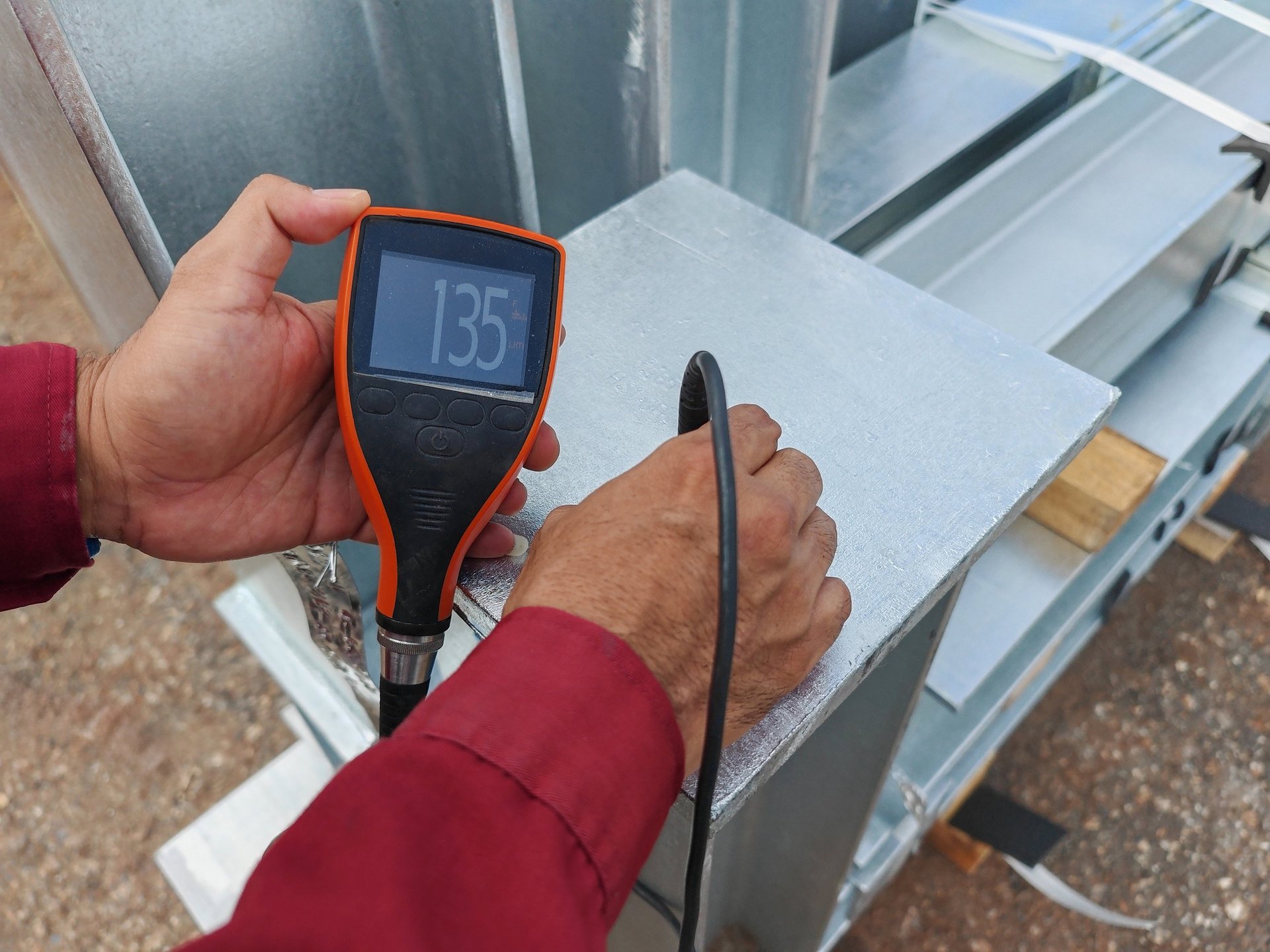
The coating is a measured quantity on a real surface. The designation describes what it should be — only a test tells you what it is.
Both sides or one?
The convention deciding whether a figure is per-surface or combined is the first thing to settle.
Mass or thickness?
Both describe the same coating — the conversion between them is arithmetic.
Designation ≠ result
A designation names what was ordered. Acceptance is a separate test with its own rule.
Coating Mass Converter
Convert the figure — then read it against the right convention
Give the converter a mass per unit area or a thickness, and it performs the arithmetic for pure zinc. It will not present the result as an acceptance decision: that requires the surface convention, the coating metal and the acceptance basis your standard defines.
Converter inputs
Reference: DX51D galvanized coil · ASTM A653 galvanized coil
Conversion result
Enter a figure to see the equivalent mass and thickness for pure zinc.
Convention & acceptance check
Enter a coating mass or thickness, then state which surface convention it uses, what the coating metal is, and whether your acceptance is a minimum or an average. The converter returns the arithmetic conversion and refuses to present a number as an acceptance result until all four are declared.
Copyable conversion summary
Galvanized coating mass — conversion summary
Input: — g/m²
Surface convention: —
Coating metal: —
Acceptance basis: —
Governing standard / edition: —
Coil thickness (mm): —
Coil width (mm): —
Quantity (tonnes): —
Destination / port: —
Document set: —
The converter performs unit arithmetic only. It does not tell you whether a coating passes, and it deliberately does not reproduce coating class tables — those figures carry the edition and scope of the standard defining them.
Reading a Coating Designation
Four questions that decide whether a coating figure means anything
A coating number is only usable once four things are established. Skipping any one of them is how the same coil ends up passing one party's test and failing another's.
Question 01
Which standard names it?
A designation has meaning only inside the standard that defines it. The same letters can carry a different requirement under a different publisher, so the standard and its edition come before the number.
Question 02
One surface or both?
The figure may be a total across both coated surfaces or a value for a single surface. The two differ by a factor of two, and mixing them is the most common coating dispute in strip trade.
Question 03
Mass, or thickness?
Mass per unit area and coating thickness describe the same coating. Converting between them is arithmetic, but the unit you quote has to match the unit the standard and the test method use.
Question 04
What counts as passing?
A minimum at a single point, an average across a sample and a stated nominal are three different acceptance rules. The number can satisfy one and fail another on the very same coil.
Designation, measurement and acceptance are three separate things
- The designation is a naming convention. It says which coating system and mass category the order is placed against — nothing about the coil in your yard.
- The measurement is what a test returns on a real sample, using a defined method, at defined positions, with a stated number of readings.
- The acceptance is the rule that turns a set of measurements into pass or fail — and it is written in the standard and the order, not inferred from the chart you happened to read.
The misread that costs the most
Quoting a total-both-sides figure against a per-surface minimum — or the reverse — produces a coil that is fully compliant and still gets rejected, because the two parties are comparing numbers that were never the same quantity. Establish the convention in writing before the test, not after the dispute.

A habit worth building
Whenever a coating figure changes hands, restate it with its standard, its convention and its unit in the same sentence. Three words — total, per-side, g/m² — prevent most coating arguments before they start.
Where the Arithmetic Stops
What a conversion cannot tell you
Unit arithmetic is reliable and narrow. These are the places where a converted number is frequently mistaken for something it is not.
Not an alloy-layer coating
The conversion assumes pure zinc at its density. A coating system that includes a zinc-iron alloy layer does not convert on a single density — the layer structure has to be read from the standard defining it.
Not a local reading
A converted figure is uniform by definition. A real coating varies across the width and along the coil, so a minimum anywhere on the surface can be below the number you calculated.
Not a test method
How the coating is stripped, weighed or gauged is defined by the standard. Two methods on the same sample can return different numbers legitimately.
Not an acceptance decision
Passing or failing is decided by the rule in the order, applied to the set of measurements the method requires. A single converted figure never decides that.

The record is what survives the coil. A coating result is only usable later if it names the method, the positions and the convention it was taken under.
Verification & Records
What a coating clause has to state to be checkable
A coating requirement is only enforceable if the record it produces can be read against it. Each item below is the detail that turns a vague instruction into something an inspector can act on.
| Clause detail | Why it has to be stated | Where it is defined | Appears in the record as |
|---|---|---|---|
| Designation & defining standard | Without it the letters have no fixed meaning | The published standard, current edition | Order clause and certificate header |
| Surface convention | Prevents the total-vs-per-side misread | The standard defining the designation | Stated explicitly in the order |
| Unit and basis | A number without its unit is not a requirement | The standard and the test method | g/m² or µm, named in the result |
| Acceptance rule | Minimum, average or nominal are different tests | The standard, and the buyer's order | Pass/fail stated against the rule |
| Test method & sampling | Method and positions change what the number means | The standard's test clause | Method named on the test record |
No coating result is reproduced on this page, because a result belongs to a specific coil and a specific test. The table describes the clause detail that makes one checkable.
Ordering & Commercial
Carrying a coating requirement into an enquiry
A coating clause that reaches a quotation intact is worth more than one corrected later. These are the commercial details that keep it intact — and the ones only the quotation can settle.
State the three-part form
Standard, convention and unit together. An enquiry that names only a class code leaves the supplier to assume the convention, which is where the mismatch starts.
Separate finish from form
The coating requirement and the coil's dimensions, tolerance and form are separate clauses. A coating class does not describe the substrate it sits on.
Name the record you need
Say which coating record the order requires and at what point it is issued. A record nobody asked for is not produced twice.
Availability & price
Confirmed against the complete specification and commercial terms. Nothing is published in advance as fixed stock, a fixed price or a guaranteed coating result.
Adjacent Flat-Rolled Forms
The same coating logic, other purchasing forms
Coating designations appear on plate and sheet as well as coil. The convention questions are the same, but the defining standard and the form differ — check the form before you carry a coil designation across.
Steel sheet
Coated flat product supplied cut to length — the coating convention carries over, but the defining standard and the ordering basis do not automatically follow.
steel sheet supplierSteel plate
Heavier product where hot-dip coating is applied by a different route and measured under a different standard entirely — a strip designation does not transfer.
steel plate supplierSource-Backed Reference
Where a galvanized coating requirement is defined
Which standard governs a coating depends on the product and the process — a strip coil and a fabricated article do not point at the same document. Read the primary source yourself before a figure becomes an order clause.
One route: coating of fabricated steel articles
Where a fabricated steel article is hot-dip galvanized after manufacture, the requirement is commonly written against ISO 1461:2022 — Hot dip galvanized coatings on fabricated iron and steel articles. It sets out the coating requirements, the sampling and testing approach and the acceptance basis for articles galvanized after fabrication. Its scope is fabricated articles — it is not the standard for continuously coated strip coil, and its figures must not be read across to a coil designation.
What the source does — and does not — settle
- It shows how a coating standard defines its own sampling, test and acceptance basis.
- It illustrates why the governing document, not a chart, is what makes a coating enforceable.
- It does not govern continuously galvanized strip coil — a coil order points at a product standard for coated flat product, not this one.
- It does not confirm any supplier's certificate, stock, origin or price — those are commercial questions answered at quotation.
Establishing the governing document
- 1Identify the product form — continuous coil, sheet, plate or a fabricated article.
- 2Find the standard that covers that form and that coating process.
- 3Read its designation clause and its test clause — they define convention and acceptance.
- 4Write the order clause from that, then convert units only within it.
Information current as of . Verify the current edition and its scope with the publisher before relying on any figure.
FAQ
Questions a coating estimator or auditor asks
Direct answers on reading a coating designation, converting its units and checking the result — and where this page's scope ends.
Is the coating mass on a designation for one side or both sides?
Can I convert between a coating mass and a coating thickness?
Why does the same coating class appear with different numbers in different sources?
Can you confirm price, availability or a coating class for my order?
Which pages should I use next?
Procurement Path
Four decisions between a coating figure and an enforceable clause
A short path that keeps the convention ahead of the commitment — no step asks you to have a price before you have a specification.
01
Name the standard
Establish which document defines the coating designation for your product form, and read it in the current edition.
02
Fix the convention
State whether the figure covers both surfaces combined or one surface, and write that into the clause explicitly.
03
Set the acceptance
Decide whether you are buying a minimum, an average or a nominal, and name the unit the record must use.
04
Request the record
Say which coating record the order requires and when it is issued, so the incoming check has something to read against.
Steps one to three are the fields in the converter above. Fill it, copy the summary, and the enquiry arrives with its convention already stated.
GCC Supply Planning
Coated coil supply into each GCC market
The order clause travels with the material. What changes by market is the submittal gate, the receiving port and the record the plant files — plan those alongside the technical basis.

United Arab Emirates
Coating class submittals
UAE coated-coil enquiries frequently attach a coating class to the order — confirm which standard defines it and which surface convention it uses before the class becomes a contractual figure.
View United Arab Emirates steel coil supply
Saudi Arabia
Project durability specs
Saudi project specifications often set a coating requirement by durability rather than by class — trace that requirement back to a nomination before quoting a coating mass.
View Saudi Arabia steel coil supply
Qatar
Submittal verification
Qatar projects gate coated material behind an approved technical submittal — state the standard, the convention and the acceptance basis so the submittal can actually be verified.
View Qatar steel coil supply
Kuwait
Coating records
Kuwait supply favours documented lots — the coating mass record and its test method travel with the material so receiving can check the figure against the one ordered.
View Kuwait steel coil supply
Bahrain
Coastal durability
Bahrain's coastal atmosphere puts the coating under sustained pressure — the durability the project wants has to be traced to a coating class and a standard, not assumed from a class code alone.
View Bahrain steel coil supply
Oman
Port-to-site handling
Oman consignments route through Sohar or Salalah — align packing and edge protection so a measured coating is not damaged between the port and the fabricator.
View Oman steel coil supplySupply planning is confirmed against the complete specification, the named port and the commercial terms — never published in advance as a fixed schedule or as company presence in every destination.
Request a Quote
Send the coating clause with its standard, convention and acceptance basis, and the commercial department responds with availability and pricing. Price is always on request.
Office 3303, Churchill Executive Tower, Business Bay, Dubai, United Arab Emirates
Monday – Saturday: 8.00 AM – 6.00 PM · Sunday: Closed
Not sure what to send?
Start with the designations standard, the surface convention and the acceptance basis. Add the unit, the coil dimensions and the record you need — everything else can be confirmed during quotation.