
Stainless Steel Hollow Section · Material Route
Stainless Steel Hollow Section
Stainless is a family, not a specification, and the family name will not select the right member. What selects it is the environment the section sits in — coastal chloride, industrial atmosphere, wash-down or interior — together with the surface finish, the fabrication route and the treatment of the welded joint. Describe the exposure first, then confirm the grade, standard and edition, section shape, dimensions with units and the surface and inspection requirements.
Price on request · availability, origin and document package confirmed against the live enquiry
Choose the route that fits the requirement
Specify Stainless Steel Hollow Section around the job
Stainless Steel Hollow Section is only a useful purchase description when the governing requirement, dimensions, service conditions, testing and document expectations are stated with it. Treat nearby routes as comparisons, not automatic substitutes. Price, stock, origin, certification and delivery timing are confirmed only against the live enquiry. Start with the requirement that decides fit, then provide the missing order inputs.
Material route — stainless
Stainless is a material route, not a grade or a finish name. The grade family and its governing standard fix the chemistry, mechanical properties and corrosion behaviour, so they are decided separately from the section shape and the surface finish.
Service environment & corrosion exposure
Corrosion exposure is the decision that most often changes the grade and the surface requirement. State the environment explicitly, then confirm the grade and finish the service actually calls for — never inferred from the words "stainless steel".
Governing standard & edition
The standard and its edition fix scope, grade range, tolerances, testing and ordering requirements. Name the edition so the mechanical, dimensional and document basis is auditable rather than assumed.
Shape, dimensions & tolerance
Shape class (square, rectangular or circular), nominal dimensions with units, wall and the applicable tolerance regime fix the piece. A nominal chart value is not an acceptance tolerance unless the governing document says so.
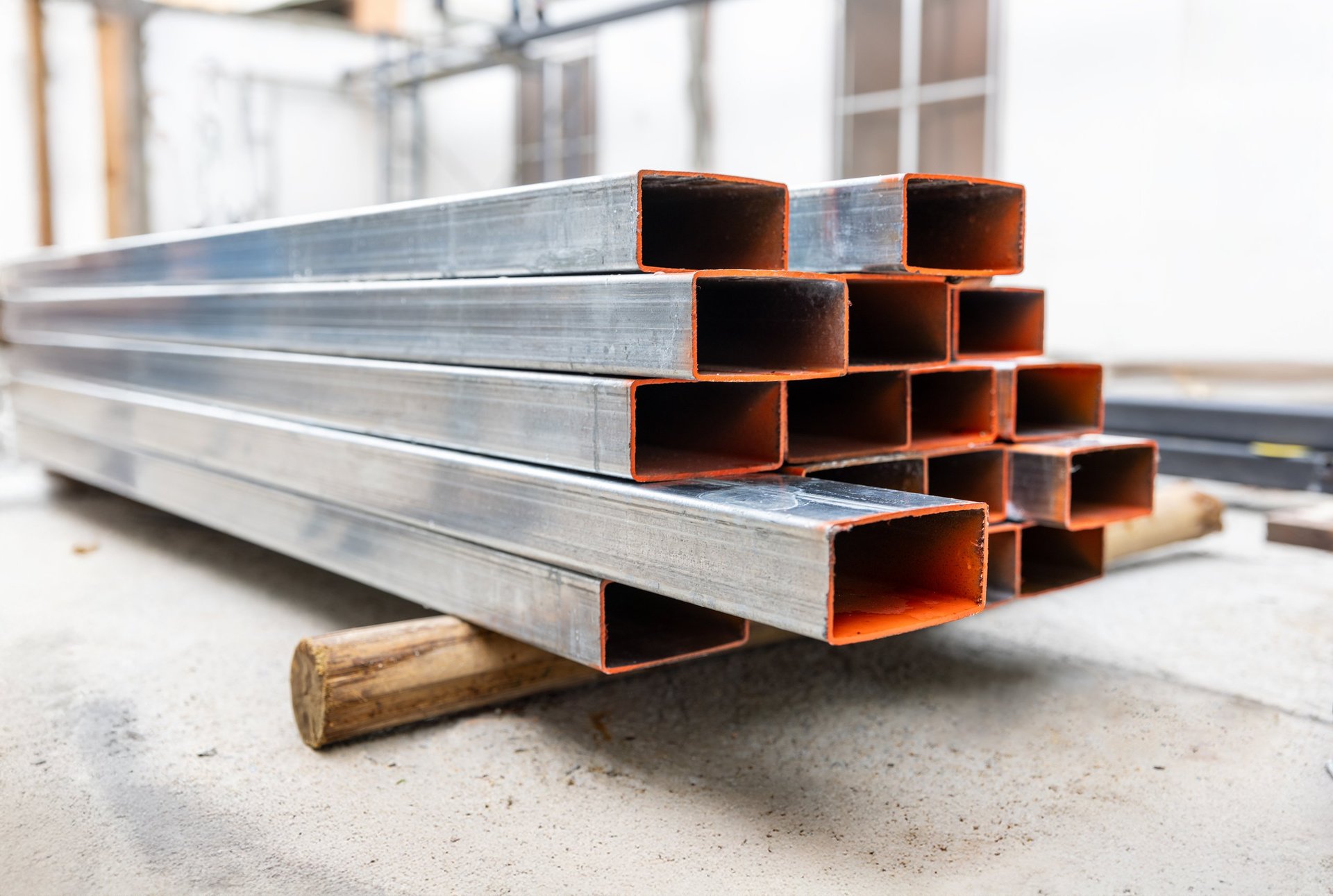
Describe the environment, then the finish
Confirm the duty, environment and fabrication route first
Stainless is not one material, and the family name will not select the right one. What selects it is the environment the member sits in — coastal chloride, industrial atmosphere, wash-down, or an interior where appearance carries more weight than corrosion resistance — together with how the surface is finished and how the joints are made. Tell the enquiry where the section will be and what it will be exposed to, and note whether the joint area has to be cleaned or passivated after welding, because that decision affects the fabrication sequence as much as the grade.
Specification gate
Build a checkable enquiry
The specification gate asks for governing standard and edition, grade or material route, section shape, dimensions with units, quantity and unit basis, service, fabrication/connection method, inspection needs, document list and destination. The summary separates confirmed inputs from open items so the RFQ never fills a missing value by assumption.
RFQ summary
Standards, grades, dimensions & condition
Write the specification so offers can be compared
For a stainless route the family is only the beginning: write the exact grade or alloy designation, the finish, and the service exposure the choice depends on. Then add the standard and edition, the section and dimensions with units, quantity and unit basis, the fabrication and inspection scope, the documents required and the destination. The finish and the service environment are stated inputs, not inferences from the word stainless.
Standard, edition & grade class
The governing standard and its edition fix the grade range, chemistry, mechanical minimums, tolerances and testing for the stainless material route. Name the full grade or class rather than a family nickname, and confirm the delivery condition separately.
Dimensions, wall & tolerance regime
State the section family, nominal dimensions with units, wall, length or cut requirement and surface requirement together, and name the tolerance regime the governing document references. A nominal chart value is not an acceptance tolerance.
Service environment & surface finish
Corrosion exposure and surface requirement are separate inputs the governing requirement controls. Order a finish or corrosion-verification step only where the service actually calls for it, never as a default.
Reference before ordering
Confirm a dimension or size input before it reaches the RFQ
Use a reference to check scope and terminology, then compare that scope with the project requirement. A reference does not replace the contract documents for the actual order.

| Requirement context | Governing basis | Applies to / limitation | Keep as a separate decision | RFQ field |
|---|---|---|---|---|
| Stainless hollow section to a named product standard | Standard and edition named by the project | Applies where the governing document specifies a welded stainless hollow section. Confirm the edition, grade range, tolerances, testing and ordering requirements against the project requirement. | Grade, delivery condition, tolerance regime, surface finish | Standard / edition + grade |
| Grade selected for a corrosive or exposed environment | Governing project specification / code | The environment drives the grade and finish choice. It is a comparison path only until the governing requirement accepts the grade — never an automatic substitute for another route. | Service environment, surface requirement, inspection scope | Environment + finish |
| Project specification beyond the standard | Governing project specification / code | Where a project specification imposes requirements beyond the standard, those requirements are ordered explicitly and confirmed against the actual supply. | Supplementary requirements, inspection scope, documents | Supplementary requirements |
This table is a decision aid only. Technical choices are conditional on the selected standard and grade, and it carries no numerical technical value; every dimension, tolerance, condition or test figure is confirmed against the governing standard, edition and the material certificate before quotation. Price on request.
Documents & inspection
Match documents and inspection to the order
Stainless documentation usually needs to show more than mechanical results — the grade, the surface condition and sometimes the treatment of the welded joint. Decide what your inspector will want to see, name the certificate and the standard it should reference, and confirm that what you are asking for can be supplied for the consignment, because not every treatment is evidenced the same way.
- Material certification and traceability for the steel supplied, per consignment
- Chemistry and mechanical test record against the governing standard, edition and grade
- Corrosion or surface-finish verification only where the order requires it
- Dimensional and inspection records where the order requires them
- Condition and surface checks against the agreed route
- Heat / lot traceability to the shipped consignment
- Commercial invoice and packing list
- Shipment / origin documents only where applicable to the consignment
- Customs declaration inputs for the destination

What is evidenced, and what stays order-specific
- Material certification and traceability are requested for the steel supplied, against the governing standard, edition and grade — never an assumed certificate.
- Heat-treatment and delivery condition records are requested only where the governing standard and the order require them, and the record is named in the enquiry.
- Availability of any certificate or approval is confirmed for the actual supply — not assumed from this page or from a nearby route.
Operating duty
Where operating duty changes the choice
Open an application page when the end use changes the exposure — a coastal installation and an interior balustrade place very different demands on the same stainless family. Where the exposure does not change, the grade and finish decision above stands. The same stainless family behaves very differently by location — a coastal install, an industrial atmosphere and a washed interior each call for a different grade and finish combination.
Manufacturing
Manufacturing context: confirm grade, surface requirement, tolerances, mechanical evidence and the fabrication route before the specification is frozen.
Explore ManufacturingColumns
Column duty: reconcile shape, nominal dimensions, wall, grade and the governing design basis before the enquiry is fixed.
Explore ColumnsMachinery frames
Frame context: check whether connection detailing, corrosion exposure, finish, inspection or documentation changes the order.
Explore Machinery framesGCC markets & destination planning
Plan the GCC destination separately from the steel specification
Keep product compliance separate from destination planning. Confirm consignee/importer details, named port or inland delivery point, Incoterms rule and named place, shipment documents, any permit/conformity steps required for the actual goods, and the party responsible for each action. No country card implies a local office, warehouse or stock position.

United Arab Emirates
Destination & importer inputs
Move from Stainless Steel Hollow Section selection to the exact UAE procurement route: carry the standard edition, grade, surface finish, section shape, dimensions, quantity and destination emirate so the quotation and document set match the import.
United Arab Emirates hollow-section procurement
Saudi Arabia
Project specification & import inputs
Confirm the standard and edition, grade, finish, shape, nominal dimensions, tolerance regime, quantity and required-on-site date so the estimate and logistics stay aligned to the governing project specification.
Saudi Arabia hollow-section procurement
Bahrain
Industrial supply inputs
Coordinate the standard edition, grade, corrosion-exposure requirement, inspection needs, document list and delivery point to the Bahrain requirement so the section and its document set stay aligned.
Bahrain hollow-section procurement
Kuwait
Contractor procurement inputs
Link stainless hollow section selection and any cutting or processing to the fabrication and inspection needs, with the delivery point and Incoterms named place agreed against the requirement.
Kuwait hollow-section procurement
Oman
Port-oriented supply inputs
Confirm the specification, dimensions, quantity, document package, port and Incoterms rule so the Oman quotation and logistics stay aligned to the order.
Oman hollow-section procurement
Qatar
Specification & delivery inputs
State the standard and edition, grade, finish, shape, dimensions, condition, documents and delivery location so the Qatar quotation is fixed on a verified basis.
Qatar hollow-section procurementCommercial inputs
Commercial inputs that remain quotation-dependent
Stainless is priced against the exposure as much as the section. The supplier needs the environment the member will see, the grade and finish you intend, the shape and dimensions with units, any post-weld treatment, the quantity and unit basis, the documents, the destination and the named Incoterms place. Availability and delivery timing are confirmed against the live shipment.
Packing
Sections bundled, strapped, tagged and marked by shape, nominal size, wall, grade, heat and lot, matched to the declared route. Surface protection expectations are confirmed in the enquiry.
Delivery point & schedule
Name the consignee or importer, the port or inland delivery point and the required-on-site date. Timing is checked for the live shipment and stated on the quotation.
Incoterms rule & named place
State the Incoterms rule and the named place so packing, transport and document obligations are explicit, and name the party responsible for each action.
Carry the enquiry into the commercial department
Turn the exposure, the grade and finish you intend, the standard and edition, shape, dimensions, any post-weld treatment, documents, quantity, destination and Incoterms named place into one copyable summary. The commercial department reviews the exposure against the grade before quoting, so a finish or treatment that does not suit the service is raised early.
Price on request — freight, duty, availability and delivery timing are confirmed with your quotation.
Technical reference
Confirm the source scope, then compare it with the requirement
Use the standards referenced to confirm how grades and finishes are classified, then check that classification against the exposure your member will actually see. A standard classification is a starting point for the conversation, not a service assessment.
American Institute of Steel Construction — HSS resources
Published reference scope · reviewed for scope and terminology
The American Institute of Steel Construction publishes HSS resources covering hollow structural sections and how they are described and used. Use the reference to confirm its own published scope and terminology, then compare that scope with the project requirement for the actual order.
What this means for your order: the reference helps fix the questions that must be answered in the RFQ — the standard and edition, the grade, the section shape, the nominal dimensions with units and the tolerance regime. Conformity, certification and commercial outcomes remain separate, verification-dependent steps after the technical product description is complete.
What it does not cover: the reference does not prove Noor Deira Steel inventory, price, certification, local presence or project approval, and it does not replace the contract documents for the actual order. Verify the purchase order and the current licensed standard, because a project specification can impose requirements beyond it.
What a complete enquiry improves
A complete enquiry makes three things easier
Stainless enquiries go wrong when the environment is described loosely and the grade is chosen from habit. Stating the exposure, the finish and the post-weld treatment up front means the grade and the surface route are settled together, and the offer reflects the service the member will actually see.
Buyer concern
Specification from a material nickname
Evidence-led answer
Every value is forced against the governing standard and edition, grade, shape, nominal dimensions, tolerance regime and surface requirement — never assumed from the words "stainless steel".
A stainless steel hollow section whose basis is an auditable, order-driving input set.
Buyer concern
Automatic substitution between nearby routes
Evidence-led answer
The enquiry keeps the standard, grade, product form, delivery condition, dimensions, tolerance regime and finish as separate decisions, so a nearby route is only a comparison until the governing requirement accepts it.
A section that matches the governing document rather than a similar-sounding catalogue line.
Buyer concern
Dimension and tolerance ambiguity
Evidence-led answer
Nominal dimensions with units, the tolerance regime referenced by the governing specification, and any length or cut requirement are carried together.
A section a fabricator can cut, weld and re-check against the governing document.
Buyer concern
Unspecified corrosion or finish requirement
Evidence-led answer
Corrosion exposure and surface requirement are named explicitly as their own inputs, so the grade and finish are confirmed against the service rather than assumed.
A grade and finish that match the environment the section will actually see.
Buyer concern
Quotation gaps and destination surprises
Evidence-led answer
Processing, packing, destination, Incoterms named place, documents and required-on-site date are separate explicit fields, never buried in a price.
A quotation that states delivery and import expectations instead of hiding them.
From requirement to quotation
Every step names its owner, input and open item
Seven steps take a stainless requirement to a delivered consignment, with the exposure, grade and finish settled together at the start rather than corrected at fabrication.
Requirement
Buyer
In: Governing standard and edition, grade or material route, shape, nominal dimensions with units, quantity and unit basis.
Out: Service and governing document defined; route identified.
No standard or edition named.
Next: Name the standard and edition.
Environment & finish
Buyer + technical
In: Corrosion exposure, surface requirement, delivery condition, tolerance regime.
Out: Environment and finish basis stated.
Environment or finish left implicit.
Next: Fix environment and finish inputs.
Tests & documents
Technical / inspection
In: Testing and inspection scope, required document list with expected issuer.
Out: Evidence and document package named.
Documents assumed, not requested.
Next: Confirm the document checklist.
Destination & importer
Buyer + commercial
In: Consignee / importer details, port or inland delivery point, Incoterms rule and named place.
Out: Destination and clearance owner explicit.
Importer or named place not confirmed.
Next: Add importer and named place.
Quotation
Commercial
In: Quantity and unit basis, processing scope, packing, documents and required-on-site date.
Out: Availability, commercial terms and document package confirmed for the live enquiry.
Open items carried into the offer.
Next: Receive the confirmed offer.
Packing & shipping
Supplier / forwarder
In: Strapping, tagging, marking, Incoterms rule, port.
Out: Coordinated to the named delivery point.
Document delay.
Next: Track to the delivery point.
Delivery & follow-up
Commercial
In: Site handover, closed-out documents.
Out: Handed to site with the document set.
Open claims.
Next: Close out.
Review unresolved items before quotation
Standard and edition, grade, product form, dimensions, condition, testing and document inputs, quantity, destination and commercial terms enter the enquiry together so the specification, the evidence and the delivery terms stay aligned.
Request a QuoteBuyer FAQ
Questions to settle before ordering
The questions a stainless enquiry turns on: which grade suits the exposure, how much the finish matters, and what has to be settled before the order is placed.
Which stainless grade suits my exposure?
Does the finish matter as much as the grade?
What has to be confirmed before the order?
What belongs in the RFQ?
Qualified RFQ
Request a qualified Stainless Steel Hollow Section quotation
Send the governing standard/edition, grade or material route, section shape and dimensions with units, quantity/unit basis, intended service, fabrication or connection notes, tests/inspection, required documents, destination and named delivery place. If an item is still undecided, mark it open rather than guessing. The quotation will confirm availability, commercial terms and the supply-specific document package.
Price on request · availability and commercial terms confirmed against the live enquiry
Related routes worth comparing
Open a related page to resolve one decision
This page is about selecting a stainless route from the environment and finish. If the real question is which forming route or which standard applies, the type and standard pages are the closer match; the structural steel family is a neighbouring product group, not a substitute.
Stainless steel products
A bounded adjacent route that groups the stainless family for comparison when the buyer needs to see the wider material range rather than an interchangeable substitute.
Compare Stainless steel productsStructural steel products
Structural steel is linked as a comparison for the structural role, not for the material. A carbon open profile does not carry the corrosion behaviour that put you on this page, so compare only where the material choice is genuinely still open.
Compare Structural steel products