
Steel Billet · Grade
5SP Steel Billet Supplier
5SP is a GOST 380-2005 carbon-steel grade designation, not a generic “better billet” label. Procurement must verify the governing standard, heat chemistry, billet geometry, downstream mill target and any additional acceptance criteria; do not substitute 5SP for 3SP or another grade without engineering review.
Five reads higher than three, which is exactly why this grade gets ordered for the wrong reasons. It is a specific designation inside a specific standard — not a premium tier, and not a safe upgrade over another grade. What makes it right is what your mill has to roll it into.
Standards, dimensions and evidenceSuitability is judged on these, not on the grade number
- Governing standard and editionThe document the designation is read against. A grade number alone is not a specification.
- What the billet must roll intoThe finished product's own requirements are what make one grade right or wrong.
- Billet size and cut lengthNominal section and length with their tolerance basis, matched to the mill's charge.
- Ductility and weldability contextIf the finished product must bend or be joined, say so — it changes what the grade has to deliver.
- Heat evidence and inspection scopeWhich elements the certificate reports, and how the delivered bundle is tied to its heat.
No chemical composition, mechanical property or dimensional tolerance value appears on this page. Those belong to the governing standard edition and your order documents.
Selection logic
When 5SP is the right call — and when it is just a bigger number
There is a version of this decision that is made properly, from what the finished product has to do, and a version made from the grade number. They look identical on an enquiry sheet and they end differently.
Fits when
- The finished product's requirements point to this grade — strength, hardness, ductility or weldability — rather than the grade number looking like the stronger choice.
- The receiving mill has been told which grade is coming and has confirmed its pass schedule and cooling practice suit it.
- The order names GOST 380-2005 with its edition, so the certificate can be held to a defined text.
- Heat analysis, the elements to be reported, and the marking tying a bundle to its heat are agreed before dispatch.
Does not fit when
- The grade was chosen because 5SP reads as a higher number than 3SP, with no downstream requirement behind the decision.
- A substitution is being made against a mill that engineered its process around a different grade and has not been asked.
- Two grades are being charged through the same program without heat-lot separation, so the rolled product's identity is lost.
- The enquiry states the designation but not what the billet has to become, leaving suitability untestable.
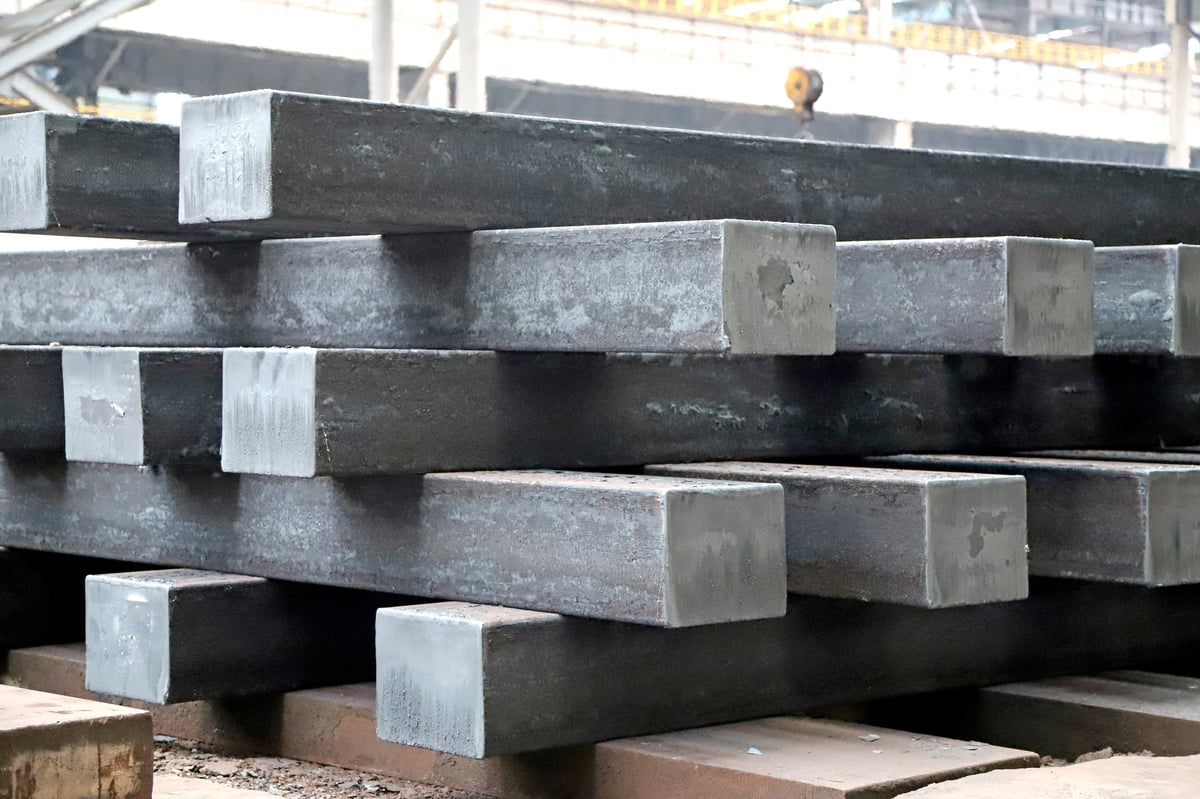
Closest registered alternatives
Carbon steel billet
Compare when the material family is still open and no grade designation has been fixed.
Boundary: The family narrows the field but specifies no chemistry — the grade decision still has to be made.
carbon steel billet supplierContinuous casting billet
Compare when the production form is the open question and the grade is already settled.
Boundary: The casting route describes how the form was produced; it sets no chemistry or acceptance limit.
continuous casting billet supplierRebar-grade billet
Compare when the billet is destined for reinforcement and the finished-bar standard governs.
Boundary: A rebar-grade billet is not itself a rebar grade — the bar is qualified under its own standard.
rebar billet supplierDecision tool
5SP Suitability & Comparison Gate
Answer seven questions and this tells you whether the grade choice holds up, what your mill needs to know about it, and what is still unresolved. It will not tell you 5SP is better than anything — it has no view on that, and neither should a grade number.
2. Suitability result
Nothing to assess yet — five answers are still open
- GOST reference and edition
- 5SP heat analysis availability
- Downstream finished product
- Billet size and length
- Ductility / weldability context of the finished product
The last two questions are optional, but they are the ones that surface a grade substitution or an unagreed document set.
Standards, grades & dimensions
What the 5SP designation actually settles
A grade number tells you which row of a standard you are in. It does not tell you the composition limits, the tolerances or the acceptance conditions for your order — those are read from the controlled text and written into your documents.
Governing standard — what is established, and by what
The designation only means something inside its own document. This is what the official record establishes, where the source stops, and what has to come from your order instead.
| Item | What is established | Source & method | Condition |
|---|---|---|---|
| Standard reference | GOST 380-2005 — common-quality carbon steel | Rosstandart official record, consulted 2026-10-03 | Cite the edition on the order; the grade is read against a specific text |
| Status | Shown as active in the official record | Rosstandart official record, consulted 2026-10-03 | Re-verify at order time — status can change between enquiries |
| Billet within scope | Continuously cast and rolled billets are among the product forms covered | Rosstandart official record, scope statement | Scope inclusion says the standard reaches billet; it does not fix your order |
| Grade chemistry | Not stated here — read from the controlled standard text | — | Request the applicable limits with your enquiry rather than assuming them |
| Dimensions and tolerances | Not stated here — order-specific and mill-dependent | — | The size table below is a geometric basis, not a tolerance specification |
| Mechanical properties | Properties of the rolled product, not the billet | — | Established downstream under the finished product's own standard |
Evidence warning. Status and scope statements above come from the official standard record. No chemical composition, mechanical property or dimensional tolerance value is published on this page, because those belong to the controlled standard text and to the conditions you write into your own order — not to a web page describing the grade.
Where 5SP sits among the grades buyers ask about
The column that matters here is the last one. It says what would have to happen before one of these could stand in for another — and in every case that is a written engineering decision, not a swap of a number.
| Designation | Governing family | Relationship to 5SP | What a substitution requires |
|---|---|---|---|
| 5SP | GOST 380-2005 | This designation | Cite the edition and confirm the spelling on the order |
| 3SP | GOST 380-2005 | Different grade, same standard | Receiving mill approval — the rolled product is made from different material |
| Other GOST 380 grades | GOST 380-2005 | Different grade, same standard | Receiving mill approval, documented against both grades |
| Q235B | Chinese national standard | Cross-standard comparison only | Written comparison against both governing documents, filed with the order |
| S235 | European structural standard | Cross-standard comparison only | Written comparison against both governing documents, filed with the order |
| Rebar grades | Reinforcement standards | Not equivalent — different product and acceptance | The finished bar is qualified under its own standard |
Note the difference between the two middle rows and the rest. Moving between GOST 380 grades is a change of material within one document — still the mill's call, but comparable on its face. Moving to a different standard's designation is not comparable at all, and needs the full written comparison before anyone treats it as settled.
Billet geometry — dimensional basis
Nominal cross-sectional area and the unit mass that follows from it. Area is the exact nominal square (side²); mass is calculated from that area at a steel density of 7,850 kg/m³. Both are planning figures — a labelled engineering assumption, not an acceptance value. The range shown is commonly requested sections, not a stock list.
| Nominal side (mm) | Nominal area | Indicative unit mass | Method & basis | Typical downstream use |
|---|---|---|---|---|
| 100 × 100 | 10,000 mm² | ≈ 78.5 kg/m | side² at 7,850 kg/m³ | Wire-rod and small-section feedstock |
| 125 × 125 | 15,625 mm² | ≈ 122.7 kg/m | side² at 7,850 kg/m³ | Bar and light-section rolling |
| 150 × 150 | 22,500 mm² | ≈ 176.6 kg/m | side² at 7,850 kg/m³ | Bar, rebar and section rolling |
| 160 × 160 | 25,600 mm² | ≈ 201.0 kg/m | side² at 7,850 kg/m³ | Heavy bar and section production |
Tolerance, straightness, corner condition and cut-length variation are order-specific and confirmed against the receiving mill. Quoting a tolerance without its governing basis produces a number nobody can enforce, so none is stated here.
Mechanical properties — and why the billet cannot show them
A billet has not been rolled. It carries no tensile, yield or elongation value to certify, because those are properties of a finished, tested product. What you control at billet stage is the composition — and the composition is what makes the downstream values reachable, not what proves them.
Properties belong downstream
Yield, tensile and elongation are established on the rolled product under its own standard. Printing them against a billet would describe something that does not exist yet.
Composition is the input
The grade fixes a composition route. That is the lever you actually hold at billet stage, and it is why the heat analysis matters more here than a property table would.
The route decides the result
Reduction and cooling practice turn the same composition into different properties. Whether your mill reaches the required values is the mill's process capability to confirm, not the certificate's.
Related specification paths
150 × 150 mm steel billet
A section route, not a grade route. Settling the section does nothing to settle which grade your product needs — they are separate decisions.
150x150 steel billetSteel billet chemical composition
Background on the composition basis for a billet order. It explains the field, not a value for this grade — those come from the controlled standard text.
steel billet chemical compositionQuality, testing & documentation
The verification matrix
A grade name on a certificate is a claim. Working down this table is how you turn it into something you can accept or reject — what you have to specify, what evidence to ask for, who signs off, and what it costs when a line is missed.
| Requirement | Buyer must specify | Evidence to request | Acceptance owner | Risk if missing |
|---|---|---|---|---|
| Grade identity | The standard and edition, and the designation exactly as the text prints it | Stated in the order documents as the governing basis | Buyer's technical authority | The grade cannot be assessed against a document nobody named |
| Heat analysis content | Which elements the certificate must report | Mill test certificate carrying the heat analysis | Buyer's technical authority | A certificate omitting a relied-on element cannot support acceptance |
| Heat traceability | How heat identity is marked and what the marking must survive | Heat number on the bundle, tied to the certificate; marking method stated | Buyer / mill quality function | The rolled product loses its identity the moment lots are mixed |
| Grade separation at the mill | Whether more than one grade will be charged through the same program | The mill's written handling arrangement for each grade | Receiving mill | Two grades through one program produce output that cannot be certified either way |
| Forming / joining requirement | Whether the finished product must bend, form or be welded | The finished product's own standard and its test requirements | Buyer's technical authority | Grade chosen without this input may not suit the product it is bought for |
| Dimensions | Section, cut length and the tolerance basis | Dimensional record against the order | Receiving mill | Section that does not suit the pass schedule or the charge |
| Surface and end condition | Quantified defect limits and the inspection basis | Visual and dimensional inspection record | Receiving mill | Defects carry into the rolled product rather than being reduced out |
| Shipment documents | Document set, language and issue timing | Certificate, packing list and documents per the Incoterm | Buyer's commercial function | Release, clearance or payment is delayed at destination |
Certification limit. Nothing here should be read as an assertion that a certificate, approval or test report is already held or issued, or that any given composition will reach a particular rolled-product outcome. Content, issuing party and timing are settled against your order. No certificate is created here and none is implied.
Application & industry paths
Which rolling program decides whether 5SP is right
Pick the route closest to yours. Each one shows what the operating requirement asks of the grade, what it implies for your choice, and where the limit of that reasoning sits.
Bar and section rolling
- Operating requirement
- Section and grade matched to the mill's pass schedule and the bar's own standard
- Selection implication
- This is the route where grade choice is most visible in the finished product, because bar properties are tested directly against the bar standard.
- Where the reasoning stops
- Bar tolerances and properties come from the bar standard — the billet supply does not carry them.
Rebar rolling
- Operating requirement
- Composition anchored to the reinforcing standard the finished bar must satisfy
- Selection implication
- Reinforcement acceptance runs on the finished bar's own tests, so the grade decision has to be made against that standard rather than against a preference.
- Where the reasoning stops
- A 5SP billet is not a rebar grade — the finished bar is qualified under its own standard.
Wire-rod rolling
- Operating requirement
- Composition and surface condition suited to drawing
- Selection implication
- Surface acceptance carries more weight here than in re-rolling — defects survive drawing rather than being worked out.
- Where the reasoning stops
- Drawing behaviour depends on the whole route, not on the billet alone.
GCC markets
Shipping 5SP billet into the Gulf
Customs, documentation and logistics are handled country by country on the routes below. To price a shipment we need a named port or place, an Incoterm, and the importer's document and classification position. None of that is an availability claim — it is what a quotation has to be built on.
 United Arab Emirates
Domestic mill feedstock with Dubai-based coordination.
Tell us the receiving mill and which grade its program is built around. Domestic delivery is coordinated from Dubai against the agreed section, cut length and heat separation.
steel billet supplier UAE Saudi Arabia
Mill feedstock with technical submittal approval.
Saudi routes usually need technical submittal approval before release. Settle the standard reference, the grade, the certificate scope and the named port or inland destination before anything is quoted.
steel billet supplier Saudi Arabia Qatar
QatarTechnical approval and document scope led.
Confirm the importer's document and classification position, the named port, and how long the approval sequence takes before the quotation is finalised.
steel billet supplier Qatar Oman
OmanPort-oriented supply for downstream rolling.
Name the port or inland delivery place and the Incoterm rule. The grade and billet section are harmonised with what the receiving mill's program actually runs.
steel billet supplier Oman Kuwait
Mill feedstock with production hand-off planning.
Tie the grade choice to the rolled product, and agree the shipment against the named destination and the delivery window the mill is working to.
steel billet supplier Kuwait Bahrain
Industrial supply and re-export documentation.
Industrial routes live or die on accurate paperwork. Confirm the document set, the named place and the importer's requirements before dispatch, not after arrival.
steel billet supplier BahrainBefore an offer: name the destination or port, the Incoterm 2020 rule, and the importer's documentation and classification requirements. Confirm the tariff classification for the billet form with your own customs adviser — that determination is not made on this page.
Commercial & logistics inputs
What we need before we can price this
A 5SP quotation is assembled from the inputs below. Price, stock, lead time, origin and delivery dates are not published here — they are confirmed against your enquiry, and no figure is invented to fill a gap.
Grade and standard first
Name the standard, edition and grade before anything else. Every other line in the enquiry is written against that basis.
Quantity & unit
State the quantity with its unit — pieces or MT — and whether it is one lot or a schedule across several heats.
Mass basis
Agree whether theoretical mass from nominal dimensions or actual weighbridge mass governs settlement, and the tolerance between them.
Named place / port
A named port or inland delivery place is required. A country on its own does not define the delivery obligation.
Incoterm 2020
Name the rule (EXW, FOB, CFR, CIF, DAP…). It decides who carries risk, freight and insurance at each point.
Payment & documents
State the documentary and payment requirement, and the document set the importer has to receive.
Packing, tagging & separation
Strapping, heat tagging, lifting points and how multiple grades or heats are kept apart through handling and shipment.
Inspection scope
Which inspections apply, at whose cost, and whether witnessing is required.
Open items
Anything not yet decided is carried as an open item in the enquiry, never assumed on your behalf.
Quote required. Price, availability, lead time and origin are confirmed against your enquiry. A figure published without a live basis would misstate what an order actually carries, so none is given.
Alternatives & technical resources
Where to go next
Depends what is still unresolved. If the grade is the open question, start with the sibling grades. If you know the grade and not the geometry, take a specification path. If you are still assembling the enquiry, the reference material will save you a round of correspondence.
Product hierarchy
- steel billet supplier
The full billet scope — grades, sizes, standards and the wider type range.
- steel billet grades
The sibling grade routes. Designations are not interchangeable between them.
Related specification paths
- carbon steel billet supplier
The material family this grade belongs to — useful when the family is still open.
- continuous casting billet supplier
Compare the production form when the route is the open question.
- rebar billet supplier
Compare when the billet is destined for reinforcement rather than general long product.
Technical resources
- steel billet chemical composition
Background on how composition is specified on a billet order.
- steel billet specifications
Reduce specification ambiguity before the enquiry is written.
- steel billet price
Understand the commercial inputs that shape a billet offer before you request pricing.
Expert insight
Why should 5SP be chosen from what your product needs — rather than from the number on the grade?
Source-backed procurement decision note
Start with what the source actually says
The Rosstandart record confirms GOST 380-2005 is active and that its scope covers continuously cast and rolled billets, among other product forms. So 5SP is a grade inside a real, current document that reaches the product form you are buying. That is the extent of what a designation can tell you before your own requirements enter the picture.
Notice what the record contains — and what it does not
It carries a status and a scope. It does not carry a ranking. Nothing in a standard record says one of its grades is preferable to another in the abstract, because that question has no answer outside a specific application. The grade is a definition, and definitions only score against requirements.
Why the number reads as a hierarchy anyway
Grade numbers look ordinal, and in day-to-day trade they get treated that way — three becomes five becomes better. It is an understandable shortcut and it is not a standard. When it drives a purchase, the buyer ends up specifying material against an intuition instead of against the finished product's own tests, and the error is invisible until the rolled product is tested.
The better sequence
Work backwards. Establish what the finished product must do — its strength, whatever ductility or forming it needs, whether it is welded, what standard qualifies it. Then ask which grade gets you there through your mill's process. If 5SP is the answer, it is the answer because it fits, and you can say why. If it is not, no amount of numbering changes that.
Buyer implication. Treat 5SP as a defined chemistry and grade route under GOST 380-2005, and re-check the finished-product requirements before accepting any substitution in either direction.
Primary source
Rosstandart — GOST 380-2005 official recordMethod: the source status and scope are compared against the buyer's decision; what the source establishes is separated from what remains order-specific.
Scope & limitations
- Information date
- 2026-10-03
- Scope
- GOST 380-2005 status and the product forms its scope covers, including continuously cast and rolled billets.
- Limitations
- Detailed grade chemistry and order conditions require the controlled standard text. The source does not prove Noor Deira Steel inventory, price, lead time, origin, certification or market coverage — those remain quotation and evidence dependent.
This note is an engineering aid for framing your own specification. It is not a certificate, an inspection report or a statement of compliance.
Buyer advantages
What this page does for you
Every point here starts from something buyers actually raise with us, and ends at a check you can run yourself. Nothing is a claim you have to take on trust — if you cannot verify it, it does not belong on the list.
“Isn't 5SP just the safer choice over 3SP?”
The gate treats any move between grades as a mill-approval decision and blocks the result until that approval is recorded.
You find out it is a materials change before the order, not after the bar fails its tests.
“Does the product have to bend or be welded?”
Forming and joining context is a required input, and each answer raises its own downstream caution about what the grade has to deliver.
The requirement that actually constrains grade choice gets named instead of assumed away.
“Has the mill been told what's coming?”
Mill approval is listed as its own evidence line, separate from the certificate and from your own specification.
You know whose decision the grade change is, and can ask for it explicitly.
“Could two grades end up in one charge?”
Grade separation is in the verification matrix as a mill-handling requirement with its own acceptance owner.
Mixed lots stop being something nobody thought to ask about until the rolled product is untraceable.
“Will the certificate prove the grade?”
Heat evidence is required, with the element list and heat marking named separately.
The document you receive supports the acceptance decision rather than merely accompanying the shipment.
“Am I being sold an upgrade?”
No composition, mechanical property, tolerance or superiority claim appears anywhere on this page.
The grade gets judged on your requirements, which is the only basis that holds up.
From enquiry to delivery
Who owns each step
Eight stages, from a grade appearing on a drawing to the bundle arriving at your gate. Each one names the question you are answering, what you need in hand, who is waiting on whom, and what slips when it is done late.
- Stage 1
Finished product defined
- Buyer concern
- What must the rolled product actually do?
- Required input
- The finished product's own standard and its test requirements
- Output
- A requirement the grade can be judged against
- Risk
- Grade chosen without it is chosen on preference, not on suitability
Next: Write the requirement into the enquiry before naming a grade
- Stage 2
Grade and standard fixed
- Buyer concern
- Which document is the designation read against?
- Required input
- The governing standard and edition, stated explicitly
- Output
- A grade that can be assessed against a defined text
- Risk
- A designation with no governing document cannot be verified at all
Next: Run the suitability gate and carry the reference into the enquiry
- Stage 3
Substitution decided
- Buyer concern
- Is this a grade change or a like-for-like swap?
- Required input
- The grade currently specified, and why it is being changed
- Output
- Either mill approval or a written cross-standard comparison
- Risk
- An assumed equivalence is an unverified material
Next: Get the mill's agreement in writing before the order goes out
- Stage 4
Heat evidence agreed
- Buyer concern
- What must the certificate report?
- Required input
- The element list and the marking that ties a bundle to its heat
- Output
- Agreed certificate content and traceability arrangement
- Risk
- A certificate omitting a relied-on element cannot support acceptance
Next: Confirm the content in writing before accepting the offer
- Stage 5
Quotation
- Buyer concern
- On what basis is the offer made?
- Required input
- Named place or port, Incoterm 2020, currency, mass basis and document set
- Output
- A comparable offer with open items listed
- Risk
- An unstated basis becomes a settlement dispute
Next: Compare the offer against the alternatives on this page
- Stage 6
Production, packing & separation
- Buyer concern
- Will the right material reach the right charge?
- Required input
- Confirmed section, cut length, strapping, heat tagging and grade separation
- Output
- Tagged, separated and weighed lots
- Risk
- Heat identity is lost the moment two grades share a handling path
Next: Verify the physical marking and separation, not just the certificate
- Stage 7
Intake verification
- Buyer concern
- Does the evidence hold up?
- Required input
- Certificate, dimensional and surface records, heat traceability
- Output
- Acceptance against the stated criteria, or a documented non-conformity
- Risk
- Acceptance judged against a criterion nobody wrote down
Next: Close out against the agreed terms in the order
- Stage 8
Shipment
- Buyer concern
- Who carries risk, and when?
- Required input
- Incoterm rule and the named place or port
- Output
- Freight and insurance arranged to the agreed point
- Risk
- Risk transfers at a point the buyer did not expect
Next: Confirm the risk-transfer point in writing
Buyer FAQ
Questions that decide the order
The five that come up most often once a buyer already knows what 5SP refers to and is trying to close the order. If you are still working out what the designation means, the sections above will get you there faster.
Is 5SP a billet-specific standard?
No. 5SP is a grade designation inside GOST 380-2005, a standard for common-quality carbon steel whose scope includes continuously cast and rolled billets among other product forms. The billet is one product form the standard reaches, not a standard written for billet alone. So the designation does not by itself tell you everything a billet order needs — geometry, surface acceptance and the document set are still settled against your own order.
Can 5SP replace 3SP without mill approval?
No. They are two different grades inside the same standard, and moving between them changes the properties the downstream product will be rolled from. That is a material change, not a substitution of equals, so it needs the receiving mill's agreement before the order is placed. If a mill has engineered its pass schedule and cooling practice around one grade, presenting a different one at charge is a decision the mill has to make, not one the buyer can assume on its behalf.
Which downstream properties can make grade choice critical?
The ones your finished product's own standard tests for — commonly strength and hardness where the grade choice drives them, and ductility, bend behaviour or weldability where the product has to deform or be joined. Where any of those matter, the grade decision has to be made against the finished-product requirement rather than against a preference for a particular designation. The controlling document is the finished product's standard, not the billet's.
What should an MTC show for a 5SP billet order?
The heat analysis, the governing standard and edition the certificate was issued against, and the heat number that ties the document to the physical bundle. Where your order adds requirements beyond the standard, those appear on the certificate only if they were written into the order. State which elements you need reported, because a certificate that omits one your specification relies on cannot support acceptance regardless of how complete it looks.
How should cross-standard grade comparisons be documented?
As a written engineering comparison, filed with the order. Both governing documents named by number and edition, composition and property limits placed side by side from the two texts rather than from trade shorthand, every limit one document addresses and the other does not listed as an open item, the intended downstream product tested against both, and who approved the conclusion recorded. Without that file, an equivalence is an assumption nobody can defend at intake.
Chemistry
Where the composition limits for your order come from
A grade designation points at a chemistry table; it is not the table. There are four ways a 5SP order's composition actually gets fixed in practice. Three hold up under scrutiny. One is how buyers end up with material nobody can properly accept.
The standard's own grade table
The composition limits the governing standard assigns to the 5SP designation. The cleanest basis, because the certificate is held to a published text — provided the edition is cited on the order rather than a series number alone.
Order-specific agreed limits
Where your product needs something the standard does not address, those limits are written into the order. They bind the order that defines them and should not be carried into a later enquiry without re-agreement.
Borrowed from another grade
Limits taken from 3SP, Q235, S235 or any other mark and applied because the grades are believed to match. This is the failure mode this page exists to prevent: it produces a specification neither document supports.
Not yet established
The enquiry carries a designation and no composition basis at all. A heat analysis cannot be accepted or rejected against it, so the order gets resolved by whatever the supplier issues rather than by your requirement.
No values appear here. The composition limits that apply to a 5SP billet belong to the edition of the governing standard you are ordering against and to any agreement written into your order. Printing a range on this page would invent a specification, which is the opposite of what a procurement page should do. Ask for the applicable limits with your enquiry and hold the certificate to them.
Equivalents
The two questions behind every substitution
When someone proposes that 5SP and another designation are close enough, there are really only two questions. Is it a different grade in the same standard, or a designation from a different standard altogether? The answer decides how much work the substitution needs.
Same standard, different grade
Moving between GOST 380 grades. Both designations come from one document, so they can be compared on their face — but the rolled product is still made from different material than the mill planned for.
- The receiving mill has to approve the change before the order is placed.
- The pass schedule and cooling practice may have been set around the original grade.
- Both designations should be recorded against the order so the change is visible later.
- If the mill is not asked, the substitution is a decision taken on its behalf.
Different standard altogether
Comparing 5SP with a designation from another national standard. Nothing here is comparable on its face, because the two documents answer to different committees and different schemes.
- Both governing documents named by number and edition, never by trade shorthand.
- Composition and property limits placed side by side from the two texts, element by element.
- Every limit one document addresses and the other does not, listed as an open item.
- The intended downstream product tested against both sets of requirements, not against an average.
- The conclusion, and who approved it, recorded and filed with the order.
Our position. No equivalence between 5SP and any other designation is asserted on this page, in either direction. Where a buyer raises one, the gate records it as a separate engineering case — never as a translation between two names for the same material.
MTC requirements
What the mill test certificate has to show for a 5SP order
The certificate is the document that makes a 5SP order checkable. It is also routinely asked to establish things it was never designed to establish. Here is the split, and what to do when a certificate arrives on the wrong side of it.
Heat analysis
The composition of the heat the billet came from, and the certificate's central function for semi-finished product. Name the elements that must be reported rather than accepting a standard list.
The standard it was issued against
The certificate should name the governing standard and edition. Without that, the values on it are not tied to any requirement you can accept or reject against.
Heat number and bundle identity
The heat number connects the document to physical material, and only works if the same number is marked on the bundle that arrives. It has to survive handling to the point of intake.
Grade separation record
Where several grades move through one program, the handling arrangement needs to be documented. A certificate per heat proves nothing about which heat went into which charge.
Dimensional record and its basis
Where dimensions are certificated, the record states the tolerance basis it was measured against. A measured value without its basis cannot be judged conforming or not.
What it cannot establish
Mechanical properties of the finished product, the mill's process capability, and any equivalence to another designation. Those are separate evidence held by different parties.
No certificate is promised here. Nothing on this page asserts that a mill test certificate, approval or test report is held, issued or available, or that any particular element will be reported. The document, its content, its issuing party and its timing are agreed against your order.
Qualified RFQ
Tell us what it has to become
The more of this you can supply, the more of our reply is an answer rather than an assumption. Anything you have not decided stays an open item — we will not fill it in for you.
- Product and entity
- Governing standard and edition
- Grade as written on your order
- Billet size and cut length
- Finished product and its standard
- Forming or welding requirements
- Any grade comparison under consideration
- Heat-analysis and document requirements
- Quantity with unit of measure
- Destination, named place or port
- Incoterm 2020 and your timing
The RFQ goes to the Steel Billet enquiry intake. Your suitability record travels with it.
Contact the commercial department
- WhatsApp / Mobile
- +971 56 398 0860
- Address
- Office 1015, Churchill Executive Tower, Business Bay, Dubai, United Arab Emirates
- Working hours
- Monday – Saturday: 8.00 AM – 6.00 PM · Sunday: Closed
Technical review is handled at organisation level through the commercial department. No individual contact is named on this page.